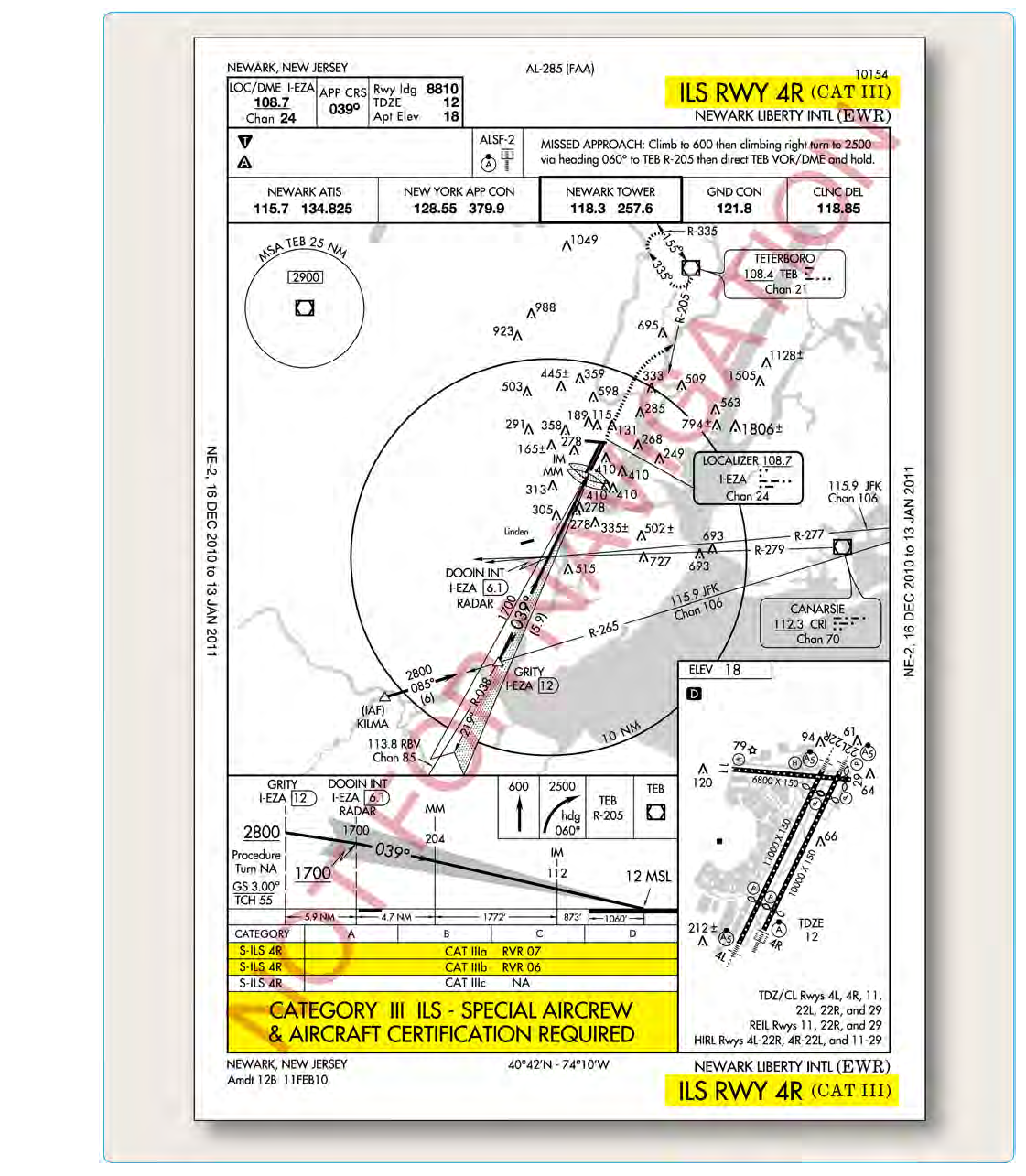
The Instrument Landing System (ILS) is the gold standard for precision approach guidance, using a localizer for lateral guidance and a glide slope for vertical guidance to lead an aircraft precisely to the runway threshold. What makes the ILS especially powerful is that it operates across multiple performance categories — Category I, Category II, and Category III — each one designed to allow operations in progressively worse visibility and ceiling conditions. As the weather minimums drop, however, the requirements for the aircraft, the crew, the ground equipment, and the airport infrastructure all rise correspondingly. For instrument students and pilots, understanding what differentiates each category is both a practical necessity and a common FAA knowledge test topic.
This article walks through all three ILS categories in detail: the weather minimums that define them, the avionics and autopilot requirements, the pilot certification and currency demands, and the airport and ground-system infrastructure that makes lower-visibility operations possible.
How the ILS Works
Before diving into categories, a brief review of ILS mechanics is helpful. The localizer transmits a course aligned with the runway centerline and provides left-right guidance, typically accurate to within about 700 feet of runway width at the threshold. The glide slope transmits an angled beam — most commonly at 3 degrees — that provides vertical descent guidance. Together they define a precise electronic pathway from the final approach fix to the decision altitude (DA) or decision height (DH).
At the decision altitude (DA) — the altitude at which the pilot must decide to land or execute a missed approach — the pilot must have the required visual references in sight to continue. If not, an immediate go-around is mandatory. The DA is expressed as an MSL altitude on Category I approaches; on Category II and III approaches, decision height (DH) is used and referenced to the runway threshold elevation (AGL). This distinction matters on the written exam.
Category I: The Baseline Precision Approach
Category I (Cat I) is the most common ILS category and the one available to any instrument-rated pilot flying a properly equipped aircraft. Cat I minimums are published on standard instrument approach procedure (SIAP) charts and typically feature a decision height of 200 feet AGL and a runway visual range (RVR) of 1,800 to 2,400 feet (or a visibility of one-half to three-quarters of a statute mile, depending on approach lighting).
To fly a Cat I ILS approach legally, the requirements are straightforward. The aircraft must have a functioning ILS receiver and the approach must be current and authorized. The pilot must be instrument rated and current (three instrument approaches, holding, and intercepting/tracking within the preceding six calendar months under 14 CFR 61.57). No special aircraft certification beyond standard IFR equipment is required. Cat I is well within the reach of a newly minted instrument pilot flying a light general aviation aircraft with a basic IFR panel.
Category II: Lower Minimums, Higher Standards
Category II (Cat II) extends ILS operations to significantly worse weather: a decision height of 100 feet AGL and an RVR of at least 1,200 feet. Getting down to these minimums safely requires much more from the entire system — pilot, aircraft, and airport.
Pilot Requirements for Cat II
Under 14 CFR 61.3(e), operating as pilot in command of a Cat II or Cat III approach requires a Category II or III authorization on the pilot's instrument rating or airline transport pilot certificate. This is not automatic — the pilot must receive specific training and a proficiency check in the applicable category. The training covers the unique visual illusions at very low decision heights, proper use of automation, and go-around procedures when visual references are acquired late or not at all.
Aircraft Requirements for Cat II
Cat II operations require aircraft that have been specifically approved and maintained for Cat II use. This generally means a flight director or autopilot capable of flying a coupled ILS approach to the DA/DH with the precision needed for Cat II, as well as a radar altimeter (radio altimeter) to give the crew an accurate AGL readout near the ground. Altimeter errors from pressure altimetry become significant at 100 feet, so a radar altimeter is essential. The aircraft must also have a current Cat II maintenance inspection and the avionics must meet the performance standards of the applicable FAA-approved Aircraft Flight Manual (AFM) supplement.
Airport and Ground Equipment for Cat II
The airport infrastructure for Cat II must be substantially more refined than for Cat I. The ILS ground equipment must meet higher integrity and signal accuracy standards. The airport must have high-intensity approach lighting (typically ALSF-2), touchdown zone lighting (TDZL), and centerline lighting (CL) on the runway. These are not optional — at 100 feet AGL in 1,200 feet RVR, the pilot has only a second or two to confirm visual references and decide to land. Runway condition monitoring, obstacle clearance areas, and critical area protection (preventing vehicles and aircraft from interfering with the ILS signal) are all strictly enforced.
Category III: The Near-Zero-Visibility Frontier
Category III is subdivided into three sub-categories — IIIa, IIIb, and IIIc — and each pushes the boundary of what human pilots and automated systems can achieve in extremely low visibility conditions.
- Category IIIa: DH below 100 feet AGL (or no DH), with RVR of at least 700 feet.
- Category IIIb: DH below 50 feet AGL (or no DH), with RVR between 150 and 700 feet. At these minimums, the runway may barely be visible at touchdown.
- Category IIIc: No DH and no RVR limitation — zero-zero operations. This category is not currently in use at any commercial airport in the United States due to the lack of a safe surface movement guidance system that can handle zero-visibility taxi operations after landing.
For Cat III operations, the pilot must hold a Cat II/III authorization with specific Cat III training. Autoland systems are typically required for IIIb and IIIc because the human visual system cannot reliably provide the needed cues at those visibility levels. The aircraft must be certified for Cat III operations in its AFM, and redundant systems — dual autopilots, redundant flight directors, multiple radio altimeters — are standard. Airlines operating Cat III aircraft undergo rigorous FAA oversight, including Line Operational Safety Audits (LOSAs) and maintenance programs specifically tailored to Cat III avionics.
Airport infrastructure at Cat III facilities must include all Cat II lighting plus strict controls on the ILS critical area. Ground vehicle movements are heavily restricted whenever a Cat III approach is in progress to prevent signal interference. Runway condition reporting (RCR) and braking action advisories become especially important because at 150 feet RVR, stopping the aircraft after landing is as critical as finding the runway in the first place.
Why It Matters
The ILS category system exists because safety margins must scale with risk. At 200 feet and half-mile visibility, a reasonably skilled instrument pilot has a workable margin to identify the runway environment and correct for small deviations. At 100 feet and 1,200 feet RVR, that margin has essentially vanished, and any deviation from the glidepath or localizer must have already been corrected by automation. At Cat IIIb minimums, the pilot may not see the runway until the wheels are on it — the entire approach must be flown by systems that are certified to a level of reliability far beyond standard IFR avionics.
Understanding these categories also matters for dispatching and flight planning. A flight planned to a Cat II-only alternate airport is useless if the crew is not Cat II qualified or the aircraft is not Cat II certified. Many commuter and regional aircraft operate Cat I only, which affects their legal alternates and filed minimums.
Key Numbers and Rules
- Cat I DH: 200 feet AGL; RVR typically 1,800–2,400 feet (or ½ SM visibility).
- Cat II DH: 100 feet AGL; RVR at least 1,200 feet.
- Cat IIIa DH: Below 100 feet AGL (or no DH); RVR at least 700 feet.
- Cat IIIb DH: Below 50 feet AGL (or no DH); RVR 150–700 feet.
- Cat IIIc: No DH, no RVR — not currently operational in the U.S.
- Cat II/III PIC requirement: Specific authorization on instrument rating or ATP (14 CFR 61.3(e)).
- Radar altimeter: Required for Cat II and Cat III; pressure altimetry is insufficient below 200 feet.
- Lighting: Cat II/III require ALSF-2, TDZL, and centerline lighting as a minimum.
- DA vs. DH: Cat I uses DA (MSL); Cat II and III use DH (AGL above threshold elevation).
- Currency: Cat I currency (61.57) does NOT satisfy Cat II/III recency requirements — separate checks apply.
Common Test Traps
- DA vs. DH confusion: The FAA exam will test whether you know that Cat I uses a Decision Altitude (MSL reference) while Cat II and Cat III use Decision Height (AGL reference above the threshold). Getting these backwards is a very common error.
- Assuming Cat I currency covers Cat II: Standard instrument currency under 61.57 — three approaches, holding, and tracking — qualifies you for Cat I only. Cat II and Cat III require a separate authorization and proficiency check.
- Forgetting the radar altimeter requirement: Students sometimes assume any IFR-equipped aircraft can fly Cat II. The radar altimeter (and autopilot/flight director) are non-negotiable Cat II requirements.
- Cat IIIc availability: Many students assume Cat IIIc is in use because it exists in regulation. It is not currently authorized at any U.S. airport — the correct answer is that Cat IIIc is not operational in the United States.
- Misidentifying RVR values: Cat I RVR is typically 1,800 feet (with best approach lighting), Cat II is 1,200 feet, and Cat IIIa is 700 feet. Mixing these up — especially Cat I vs. Cat II — is a classic knowledge test trick.