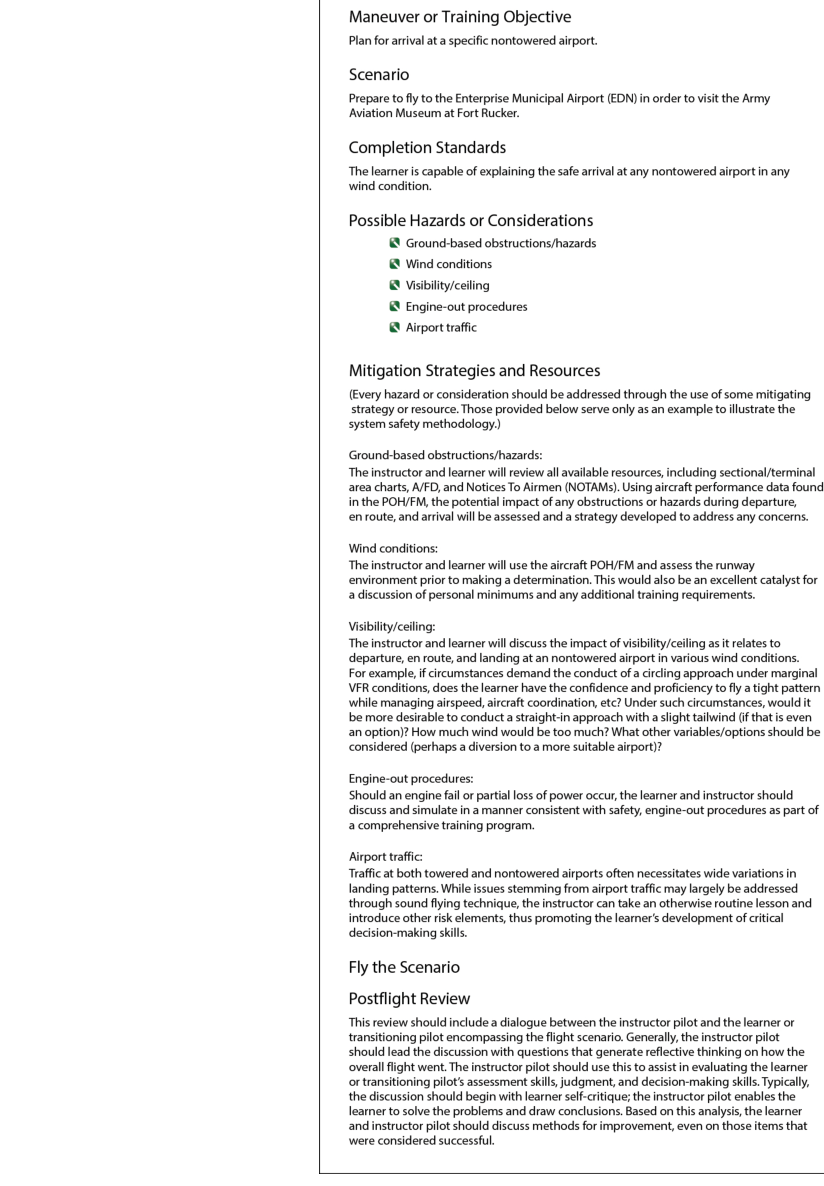
Risk management is not a bolt-on module confined to the final page of a lesson plan—it is a deliberate, pervasive design element that shapes every objective, every scenario, and every debrief in a well-constructed aviation curriculum. The Aviation Instructor's Handbook (FAA-H-8083-9) states explicitly that instructors are responsible for developing students' aeronautical decision-making (ADM) skills alongside technical proficiency, and the Risk Management Handbook (FAA-H-8083-2) provides the theoretical framework that makes this possible. When risk awareness is architected into lesson plans from day one, students do not merely learn to fly maneuvers—they learn to think like pilots who will survive the certificate.
What Risk Management Means in an Instructional Context
The FAA defines risk management as the systematic identification, assessment, and prioritization of hazards, followed by the coordinated application of resources to minimize, monitor, and control the probability and impact of adverse outcomes. For instructors, translating that definition into lesson plan language means answering three design questions for every lesson: What risks are inherent to this lesson's environment and objectives? How will the student be exposed to those risks in a controlled, teachable way? How will the instructor assess whether the student can recognize and mitigate those risks independently?
A lesson on short-field takeoffs illustrates this well. The technical objective is aircraft control during a maximum-performance departure. But the complete instructional objective—the one a risk-integrated lesson plan captures—also includes: correctly computing density altitude and its effect on accelerate-stop distance, identifying the decision point at which a takeoff abort is no longer viable, evaluating obstacle clearance margins against actual performance charts, and articulating a personal go/no-go standard before the run-up is ever performed. Technique and risk reasoning are co-equal objectives, not sequential ones.
The Four Principles of Risk Management Applied to Lesson Design
The Risk Management Handbook articulates four principles that every instructor should internalize when building a syllabus or individual lesson plan:
- Accept no unnecessary risk. Instructors should sequence lessons so students are not exposed to compounded risks before they have the prerequisite skills to manage each one individually. Night cross-country flight, for example, should not be the first time a student navigates or the first time they fly in reduced visibility.
- Make risk decisions at the appropriate level. A student solo is a risk decision that belongs to a certificated flight instructor—not to the student, the school scheduler, or the student's family. Lesson plans should identify who holds each risk decision authority at every stage of training.
- Accept risk when benefits outweigh costs. Training inherently requires exposing students to controlled risk. A lesson on stall recognition requires inducing stalls; the risk is real, and the instructional benefit justifies it. Lesson plans should articulate that justification explicitly in the objective or safety notes section.
- Integrate risk management into planning at all levels. This principle applies from the individual lesson plan to the overall course syllabus. If a ground school syllabus covers weather theory in isolation but never connects it to flight planning decisions, risk management has not been integrated—it has been mentioned.
Practical Tools Instructors Embed in Lesson Plans
The PAVE Checklist
The Aviation Instructor's Handbook introduces the PAVE checklist as a structured pre-flight risk assessment tool that instructors should model during every pre-flight briefing. The four categories are: Pilot-in-command fitness and personal minimums; Aircraft airworthiness, equipment status, and performance capability; enVironment encompassing weather, terrain, airspace, and time of day; and External pressures such as schedule demands, financial pressure, passenger expectations, and get-home-itis. By walking a student through PAVE aloud before every dual lesson, the instructor is not simply checking boxes—they are demonstrating, repeatedly and concretely, the cognitive habit that will define the student's decision-making as a certificated pilot. Lesson plans should note that the PAVE walkthrough is a required instructional element of the pre-flight briefing, not an optional warm-up.
The 3P Model
The Aviation Instructor's Handbook also describes the Perceive–Process–Perform (3P) model as the ADM cycle students should internalize. Students learn to perceive a change or hazard in the environment, process its significance by evaluating consequences and options (tools like PAVE support this step), and then perform the best risk-mitigating action available. Instructors integrate the 3P model most effectively during scenario-based training (SBT) debrief sessions, asking structured questions such as: "At what point did you perceive a developing hazard?" "What options did you consider, and what information drove your choice?" These debrief questions are not incidental—they should appear as planned discussion prompts in the written lesson plan.
The IMSAFE Checklist
Nested within the Pilot category of PAVE, the IMSAFE personal checklist addresses: Illness, Medication, Stress, Alcohol (14 CFR 91.17 prohibits acting as a crewmember within eight hours of consuming alcohol or while having a blood alcohol concentration of 0.04 percent or greater), Fatigue, and Emotion. Instructors who build IMSAFE into their pre-lesson ground discussion normalize self-assessment as a non-negotiable preflight item, not an act of weakness or an admission of incapacity.
Scenario-Based Training as the Delivery Mechanism
The FAA has clearly moved instruction toward scenario-based training (SBT) as the preferred method for developing ADM and risk management skills. Unlike purely maneuver-based training, which isolates a skill for repetitive practice, SBT embeds that skill inside a realistic operational context that carries genuine decision points. A cross-country lesson designed as SBT might present deteriorating weather en route, a destination field NOTAM discovered mid-flight, and a low-fuel scenario that forces the student to weigh divert options against schedule pressure—all in one lesson block. The lesson plan for such a session must pre-define the scenario parameters, the expected student decision points, the criteria for instructor intervention, and the debrief framework. Without that written structure, SBT devolves into improvisation, which undermines consistent safety outcomes across different students or instructors.
Lesson Plan Structure That Reflects Risk Integration
A risk-integrated lesson plan includes more than the standard elements of objective, motivation, content outline, and completion standards. It should also contain: an explicit risk assessment section identifying hazards specific to that lesson (e.g., convective weather potential during summer afternoon training, high-density traffic near class D airspace, student fatigue on back-to-back lesson days); scenario trigger points where the instructor will introduce a managed risk element; go/no-go criteria tied to measurable weather or aircraft parameters; and debrief questions designed to surface the student's risk reasoning, not just their stick-and-rudder performance. The Aviation Instructor's Handbook emphasizes that the debrief is where much of the actual learning consolidates—connecting the student's in-flight decisions to the ADM framework discussed on the ground.
Key Numbers and Rules
- 14 CFR 91.17: eight-hour bottle-to-throttle rule; 0.04 percent BAC maximum for crewmembers.
- The FAA identifies four risk management principles in FAA-H-8083-2 (accept no unnecessary risk; decide at the right level; accept risk when benefits outweigh costs; integrate risk management at all planning levels).
- PAVE, IMSAFE, and the 3P Model are all described in FAA-H-8083-9 as instructor-usable ADM tools.
- Scenario-based training is the FAA-preferred delivery method for ADM and risk management education per FAA-H-8083-9.
- External pressures are a formally recognized, FAA-documented risk category—not informal human factors to be addressed only if time allows.
Common Test Traps
- Risk management ≠ hazard elimination. The FAA is explicit: the goal is to reduce risk to an acceptable level. Attempting to eliminate all risk is both impossible and not the standard.
- PAVE is a pre-flight planning tool, not an in-flight emergency procedure. Confusing when to apply each framework is a frequent knowledge test error.
- SBT and maneuver-based training are not interchangeable. Both appear in FAA materials; both serve legitimate purposes. SBT develops decision-making; maneuver-based training develops technique. A complete syllabus includes both.
- IMSAFE is a subset of PAVE, not a separate competing checklist. It addresses the Pilot leg of PAVE in detail.
- Instructor intervention authority is a risk decision. Questions about when an instructor should take the controls or deny a solo endorsement are directly related to the principle of making risk decisions at the appropriate level.
- A lesson plan that lists risk management as a topic is not the same as one that integrates it. Integration means risk identification, mitigation strategies, and assessment criteria appear throughout the plan—not just in a safety section.
Memory Aid
Use the phrase PAVE the 3P road with IMSAFE guardrails to remember how the three tools relate: PAVE structures the overall pre-flight risk picture, the 3P model (Perceive–Process–Perform) drives in-flight decision-making, and IMSAFE provides the personal-fitness deep-dive within the Pilot category of PAVE. All three tools appear in FAA-H-8083-9 and all three should appear by name in a well-constructed risk-integrated lesson plan.