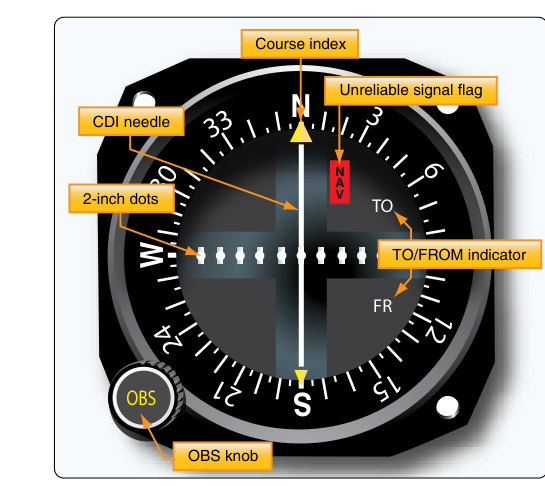
The Very High Frequency Omnidirectional Range (VOR) system is the backbone of the legacy IFR route structure in the United States. Even as GPS and RNAV have taken center stage, every instrument-rated pilot must demonstrate proficiency with VOR navigation — it remains a legal backup for most IFR operations, and VOR questions appear consistently on both the Instrument Rating knowledge test and the practical exam. More importantly, a pilot who truly understands how a VOR receiver works will interpret the Course Deviation Indicator (CDI) correctly under pressure, avoiding the dangerous errors that stem from misreading the needle.
This article walks through the complete chain: how the ground station transmits bearing information, how the airborne receiver decodes it, how the Omnibearing Selector (OBS) and CDI needle interact, what the TO/FROM flag really means, and how to apply all of this during an IFR flight — including during approaches and en-route intercepts.
How the VOR System Works
A VOR ground station transmits two signals simultaneously on a VHF frequency between 108.0 and 117.95 MHz. The first signal is a reference phase that radiates equally in all directions. The second signal is a variable phase that rotates 30 times per second like a rotating beacon. The phase difference between the two signals at any given point in space corresponds exactly to the magnetic bearing from the station — the radial. Due north of the station (magnetic) is the 360° radial; due east is the 090° radial, and so on.
Your airborne VOR receiver continuously measures this phase difference and converts it into a radial value. The OBS — the knob on your CDI or HSI — lets you manually select a desired course (called the Selected Course or OBS setting). The receiver then compares the selected course against the actual radial the aircraft is on, and the CDI needle deflects to show the difference between those two values.
Understanding the CDI Needle and Deflection
The CDI needle is not a pointer toward the station — this is one of the most fundamental misunderstandings new instrument students carry. The needle shows the angular displacement between the selected course and the aircraft's actual position relative to the station. The needle always points toward the selected course (or more precisely, toward the side of the aircraft where the selected course lies).
On a standard VOR CDI, full-scale deflection equals approximately 10° of angular error from the selected course. Each dot on the CDI face typically represents about 2° of deviation. This means that if you have a full left deflection, you are at least 10° to the right of your selected course (or the course is 10° to your left). The practical width of a VOR airway is ±4 nautical miles along the protected area at the outer boundary, but expressed in degrees, remaining within ±10° keeps you within guaranteed obstacle clearance along an airway.
Crucially, the same needle deflection represents a much larger distance off course when you are far from the station than when you are close. At 60 NM from a VOR, a 2° deflection (one dot) equals approximately 2 NM off course — the classic 1-in-60 rule. At 10 NM from the station, a 2° deflection represents less than 0.35 NM. This convergence of the radials near the station is why the FAA recommends pilots avoid making corrections based solely on CDI deflection when very close to the station cone of confusion.
The TO/FROM Flag Explained
The TO/FROM indicator (also called the ambiguity indicator) answers a specific question: if I fly the selected course, will I fly toward the station or away from it? It does NOT indicate which direction the aircraft is currently heading.
A TO flag appears when the selected course would take the aircraft toward the station, meaning the selected course differs from the bearing TO the station by less than 90°. A FROM flag appears when the selected course would take the aircraft away from the station — you are flying outbound on (or near) the selected radial. An OFF flag (or NAV flag) appears when the station is out of reliable reception range, the aircraft is in the cone of confusion directly overhead, or the receiver has a fault. When an OFF flag appears, the CDI indication is unreliable and must not be used for navigation.
A common scenario: you are tracking the 090° radial outbound (flying east, away from the station). Your OBS is set to 090°. The FROM flag appears. If you rotate the OBS 180° to 270°, the TO flag appears — and the needle reverses. This is the reciprocal course flip that confuses many students. The needle reversal happens because you have now selected a course that points back toward the station, so the geometry of left/right reverses completely.
Practical VOR Navigation: Intercepting and Tracking
During IFR flight, intercepting a VOR radial or course requires a specific technique. To intercept a desired course inbound to a VOR:
- Set the OBS to the inbound course (the reciprocal of the radial). The TO flag must appear; if FROM appears, you have set the wrong course.
- Identify where you are relative to the course — which side of the needle? Turn the aircraft toward the needle to begin the intercept.
- Use an intercept angle — typically 30° for gentle intercepts, up to 45° for sharper cuts, depending on distance and ATC instructions.
- As the needle centers, reduce the intercept angle and roll out on the selected course heading, applying a wind correction angle as needed to maintain the centered needle.
Tracking a course requires continuous attention to small CDI deviations. A disciplined instrument pilot aims to keep the needle within half-scale deflection (±5°), which at typical en-route distances is well within airway protection. On an approach, precision demands the needle stay within one dot of center.
VOR Receiver Checks
Under 14 CFR Part 91, a VOR used for IFR flight must be checked for accuracy within the preceding 30 days. Acceptable VOR check methods include a ground checkpoint, an airborne checkpoint, a VOT (VOR Test Facility) signal, or a dual VOR check (comparing two independent receivers against each other). Allowable error limits are ±4° for a ground check and ±6° for an airborne check. When using a dual VOR check (comparing two onboard receivers against each other), the allowable difference is ±4°. The date, place, bearing error, and signature of the person making the check must be logged in the aircraft maintenance records.
Why This Matters in IFR Operations
Misinterpreting the CDI is one of the most historically documented contributors to VFR and IFR controlled-flight-into-terrain accidents. The reverse sensing phenomenon — where the CDI needle appears to give opposite guidance — can happen when a pilot inadvertently sets the OBS to the wrong course. A pilot tracking inbound on a radial with the OBS set to the outbound course will see a FROM flag and reversed needle deflection. If that pilot chases the needle without verifying the flag, they will fly farther off course rather than correcting.
On VOR approaches, correct CDI interpretation is particularly critical because the final approach course must be identified precisely, the MAP (Missed Approach Point) is frequently over or abeam the VOR, and the needle becomes increasingly sensitive as the aircraft closes on the station. During the final segment, minor heading deviations produce rapid needle movement — demanding smooth, small control inputs rather than aggressive corrections.
Key Numbers and Rules
- VHF frequency band: 108.0–117.95 MHz (shared with ILS localizers on 108.0–111.95 MHz, odd tenths only)
- Full-scale CDI deflection: ±10° from the selected course
- Typical dot spacing: ~2° per dot
- 1-in-60 rule: At 60 NM, 1° ≈ 1 NM off course
- IFR VOR check currency: 30 days preceding flight
- Ground check tolerance: ±4°
- Airborne check tolerance: ±6°
- Dual VOR check tolerance: ±4° between the two receivers
- Cone of confusion: Area directly above the station where the signal is unreliable; expect OFF/NAV flag and momentary erratic needle
Memory Aid
"TO means GO, FROM means SHOW" — When the TO flag is displayed, the selected course guides you toward the station; fly it to get there. When the FROM flag is displayed, you are already past or tracking away from the station; the needle is showing you the radial you are on (or near). This reminds pilots that FROM is not a warning — it is simply geometry telling you which direction the selected course points relative to the station.
Common Test Traps
- Confusing heading with course: The TO/FROM flag depends entirely on the OBS setting and the aircraft's position relative to the station — not on which direction the aircraft is currently heading. For example, an aircraft east of the station (on the 090 radial) with the OBS set to 270° will show a FROM indication, because 270° is within 90° of the FROM bearing (090°), not the TO bearing (270° is actually the reciprocal — the point is that the flag is driven by radial position versus OBS setting, never by aircraft heading.
- Reverse sensing: Setting the OBS to the reciprocal of the desired inbound course produces a FROM flag and reversed needle. Always verify the correct flag before interpreting the needle.
- Off flag misinterpretation: An OFF flag does not mean the station is off the air — it can simply mean the aircraft is directly overhead in the cone of confusion. Plan for temporary loss of reliable VOR guidance passing directly over the station.
- Distance-deflection confusion: Students often think a centered needle means they are on course regardless of distance. Remember: near the station, even tiny errors center quickly; far from the station, a nearly-centered needle can still mean miles of course deviation if the angle is small.
- 30-day logbook requirement: The VOR check must be logged — not just performed. Failing to record it is the same as not doing it from a legal standpoint under 14 CFR §91.171.