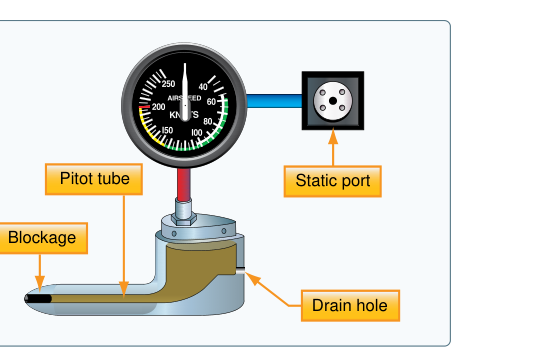
Of all the instrument failures a private pilot might encounter, a blocked pitot tube ranks among the most deceptive. Unlike a completely dead instrument, a pitot blockage can actually cause the airspeed indicator (ASI) to display changing airspeed readings — just the wrong ones, and in ways that defy instinct. Understanding exactly why this happens requires a clear picture of how the ASI is built and what it measures, so that when an anomaly occurs in flight, you can recognize it, understand it, and respond correctly.
The pitot-static system feeds two types of pressure to the airspeed indicator: ram air pressure (impact pressure from the pitot tube) and static pressure (ambient atmospheric pressure from the static port). The ASI measures the difference between these two pressures. That difference grows as the airplane speeds up and shrinks as it slows down, driving the needle across the dial. When either source is compromised, the instrument can no longer compute a meaningful difference — but the way it fails depends entirely on which source is blocked and whether any drain holes are also obstructed.
How the Pitot-Static System Works
The pitot tube is a small, forward-facing probe — usually located on the wing leading edge or nose — designed to scoop ram air and channel it to the ASI. Inside the instrument, a flexible diaphragm (or capsule) expands and contracts with changes in ram pressure. The static pressure surrounds the capsule from the other side, entering through one or more static ports on the fuselage. The net expansion of the diaphragm is mechanically translated into an airspeed reading in knots (or mph).
Crucially, the static pressure line connects not just to the ASI but also to the altimeter and the vertical speed indicator (VSI). This is why a static port blockage affects all three instruments, while a pitot blockage primarily affects only the ASI — the altimeter and VSI continue to receive static pressure and generally function normally (though the VSI may show zero rate of climb).
What Happens When the Pitot Tube Blocks
A pitot tube can become blocked by ice, insects, moisture, dirt, or even a forgotten pitot cover. The critical question is whether the small drain hole at the bottom of the pitot tube is also blocked. This determines two very different failure modes.
Blocked Pitot Tube with Open Drain Hole
If the pitot opening is blocked but the drain hole remains open, the trapped ram pressure gradually bleeds out through the drain. With no ram pressure entering and static pressure continuing to enter from the static port, the ASI reads approximately zero or very close to it. This is the more intuitive failure — the needle simply drops to the bottom of the scale and stays there, giving an obvious warning that something is wrong. The pilot loses airspeed information but is not misled by a moving needle.
Blocked Pitot Tube with Blocked Drain Hole
This is the more dangerous and confusing scenario — the one the FAA knowledge test loves to probe. If both the pitot inlet and the drain hole are blocked (as commonly happens when ice forms over the entire pitot assembly), the ram pressure is trapped inside the pitot line at whatever value existed at the moment of blockage. No new ram air can enter, and no trapped pressure can escape.
Here is the key insight: the static pressure side of the ASI continues to change normally with altitude. As the airplane climbs, ambient static pressure decreases. With the ram pressure side holding constant, the difference between ram and static pressure increases — so the ASI needle rises, making it appear the airplane is speeding up even though the actual airspeed may be constant or even decreasing. Conversely, in a descent, static pressure increases, narrowing the difference, and the ASI needle falls, suggesting a slowdown that isn't real.
In effect, the airspeed indicator begins behaving almost exactly like an altimeter. It responds to altitude changes, not to actual aircraft speed. This is particularly treacherous because the pilot may be flying a stabilized approach at constant airspeed — and watching the needle fall as if approaching a stall — when in reality the airplane is flying normally. Alternatively, on climbout, the rising needle could mask an actual deceleration toward a stall.
Why This Matters for Flight Safety
The insidious nature of a fully blocked pitot system (inlet and drain) is that it provides active disinformation rather than an obvious failure. Studies of inflight accidents have consistently shown that misleading instrument indications are more dangerous than no indications at all, because the pilot may act on false data. Imagine beginning an instrument approach in actual IMC with a blocked pitot: you slow to what you believe is approach speed, but the ASI is actually responding to your descent rather than your throttle and attitude inputs. You could inadvertently allow airspeed to decay toward a stall while the instrument seems to confirm a reasonable reading.
This is also why pitot heat is so important. Most training aircraft are equipped with an electrically heated pitot tube specifically to prevent ice accumulation. FAA guidance in both the Pilot's Handbook of Aeronautical Knowledge and the Airplane Flying Handbook emphasizes turning on pitot heat before entering visible moisture or conditions conducive to icing, not after the blockage has already occurred. Once ice fully seals the tube and drain, heat may take time to clear the obstruction, and in the meantime the pilot must fly on other references.
Key Numbers and Rules
- Pitot heat requirement: Aircraft certification standards (such as 14 CFR 23.1323) address pitot heat and equipment requirements for airplanes approved for flight in icing conditions or for IFR operations in certain aircraft. Even in VFR aircraft, pitot heat should be activated whenever icing conditions are possible.
- In a climb with fully blocked pitot and drain: Indicated airspeed increases as static pressure drops — even at constant actual airspeed.
- In a descent with fully blocked pitot and drain: Indicated airspeed decreases as static pressure rises — even at constant actual airspeed.
- With blocked pitot and open drain: Indicated airspeed drops toward zero and remains there — the safer and more recognizable failure.
- Instruments unaffected by pitot blockage alone: The altimeter and VSI rely only on static pressure and continue to function normally, giving the pilot critical backup references.
- Crosscheck value: Engine power settings, pitch attitude, and vertical speed on the VSI can all help verify whether the ASI is giving a believable reading.
Memory Aid
"Blocked pitot acts like an altimeter" — When the pitot inlet and drain are both blocked, remember that the ASI reads higher as you go higher (climb) and lower as you go lower (descent), just as an altimeter would. This phrase reminds you that the instrument is now responding to altitude, not speed. If you ever notice your airspeed rising in a level or climbing turn when you haven't changed power or attitude, or falling in a descent without a power reduction, suspect a pitot blockage and immediately cross-check attitude, power, and vertical speed.
Recognizing and Managing a Blocked Pitot in Flight
Recognition is the first step. Any time the airspeed indicator behaves contrary to your power and attitude inputs — especially if the VSI shows a climb but the ASI also shows rising airspeed at constant power — you should suspect pitot blockage. The checklist response typically includes:
- Activate pitot heat if not already on, to melt any ice obstruction.
- Maintain aircraft control by reference to attitude indicator, engine instruments, and VSI — do not chase the false ASI reading.
- Declare the instrument unreliable mentally and inform ATC if in controlled airspace or IMC.
- Use known power and pitch combinations (from your training) to approximate safe airspeeds for each phase of flight.
Private pilot training requires that you memorize approximate pitch attitudes and power settings for normal operations precisely so you can continue to fly safely when instruments fail. A blocked pitot does not make the airplane uncontrollable — it simply removes one instrument. The well-trained pilot has the remaining instruments and their own aeronautical knowledge to bridge the gap.
Common Test Traps
- Assuming a blocked pitot always reads zero: It only reads zero if the drain hole is open. If both are blocked, the ASI continues to move — and that moving needle is exactly what makes this failure so dangerous.
- Confusing pitot and static blockages: A blocked static port affects the altimeter, VSI, and ASI. A blocked pitot tube (alone) generally affects only the ASI. The test may present a scenario where multiple instruments are affected and ask you to identify the source.
- Getting the climb/descent direction backwards: In a climb, ASI reads high (not low) with a fully blocked pitot. Many students instinctively think blocking a pressure source would reduce the reading, but the behavior is counterintuitive because it is the static side that is changing.
- Overlooking pitot heat as a preventive — not just a corrective — tool: The test may ask when to turn on pitot heat. The correct answer is before entering icing conditions, not after the indicator starts behaving oddly.
- Ignoring the altimeter as a backup speed reference: A question may ask what other reference the pilot can use when the ASI is unreliable. The altimeter and VSI, combined with power and attitude, are the go-to alternatives.