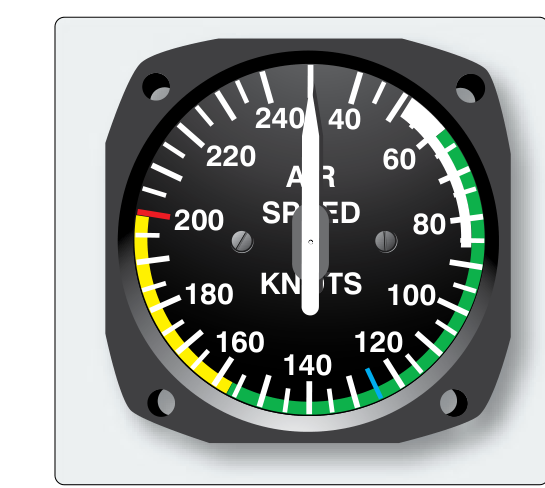
Walk up to almost any small general aviation airplane and glance at the airspeed indicator (ASI). You will immediately notice a dial divided into colored arcs — white, green, yellow, and red — each one communicating a precise safety boundary. These arcs, along with a set of named reference speeds called V-speeds, form the common language that connects the aircraft's Pilot's Operating Handbook (POH) to the instrument panel. Mastering them is not just an FAA knowledge test requirement; it is foundational airmanship every pilot uses on every flight.
This article covers exactly what each color arc and each commonly tested V-speed means, the specific numbers you must know, why they exist from an aerodynamic standpoint, and the tricky ways the FAA tests this material.
How the Airspeed Indicator Works
The ASI measures the dynamic pressure created by air entering the pitot tube, minus the static pressure sensed by the static port. The result is displayed as indicated airspeed (IAS), which is what the pilot reads directly off the instrument. IAS is not the same as true airspeed (TAS) or groundspeed — it does not correct for altitude, temperature, or instrument error — but it is the value that directly reflects the aerodynamic forces acting on the airframe. That is precisely why the color arcs are calibrated to IAS: the aircraft will stall, maneuver, or suffer structural damage at the same indicated airspeed regardless of altitude or density altitude.
The Color-Coded Arcs
White Arc
The white arc represents the flap operating range. Its lower limit is VS0 — the stalling speed or minimum steady flight speed in the landing configuration (full flaps, gear down if retractable, power off). Its upper limit is VFE — the maximum speed at which flaps may be extended. Deploying flaps above VFE risks structural damage to the flap system and the wing. The white arc is the pilot's quick reminder: extend or leave flaps extended only while the needle is in this range.
Green Arc
The green arc is the normal operating range. Its lower limit is VS1 — the stalling speed or minimum steady flight speed in a specified configuration (typically clean: flaps up, gear up, power off). Its upper limit is VNO — the maximum structural cruising speed, also called the normal operating limit. The green arc is the normal operating range for smooth air; the FAA recommends reducing speed to maneuvering speed or below when encountering turbulence, even within the green arc, since structural design gust loads assume a certain gust intensity and are not a guarantee of safety in all turbulence. Most cruise flight happens somewhere in the green arc.
Yellow Arc
The yellow arc, sometimes called the caution range, extends from VNO up to VNE — the never-exceed speed. In smooth air, the airframe can handle speeds in the yellow arc, but the pilot must exercise caution. If turbulence is present while operating in the yellow arc, structural damage or failure could result because the sudden gusts add to the aerodynamic load. The FAA advises operating in the yellow arc only in smooth air and then only briefly.
Red Line
The red line at the top of the yellow arc marks VNE, the never-exceed speed. This is a hard structural limit. Exceeding VNE can cause flutter, loss of control surfaces, or catastrophic airframe failure. No pilot, under any circumstance, should intentionally exceed the red line.
Red Arc (if present)
Some aircraft display a red arc indicating a prohibited range — speeds that must never be used even briefly. This is less common on light training aircraft but appears on some multiengine or complex airplanes where a specific speed range creates dangerous resonance or propeller issues.
Key V-Speeds You Must Know
Beyond the arcs, a set of standardized V-speed designations describes critical performance and limitation speeds. These are defined in the aircraft's POH and must be committed to memory for both the knowledge test and practical flying.
- VS0 — Stall speed in landing configuration (bottom of white arc).
- VS1 — Stall speed in clean configuration (bottom of green arc).
- VFE — Maximum flap extended speed (top of white arc).
- VNO — Maximum structural cruising speed (top of green arc / bottom of yellow arc).
- VNE — Never-exceed speed (red line, top of yellow arc).
- VA — Maneuvering speed. The maximum speed at which full, abrupt deflection of a single flight control will not overstress the airframe. VA is not marked on the ASI — it is found in the POH. Critically, VA decreases as weight decreases: a lightly loaded aircraft reaches its structural limit at a lower indicated airspeed.
- VX — Best angle-of-climb speed. Produces the greatest altitude gain over the shortest horizontal distance. Used when climbing over an obstacle just after liftoff.
- VY — Best rate-of-climb speed. Produces the greatest altitude gain in the shortest time. Used for normal climbs to altitude.
- VR — Rotation speed. The speed at which the pilot initiates the pitch-up to lift off during takeoff.
- VG (or VGLIDE) — Best glide speed. The speed that maximizes glide distance during an engine-out emergency. Found in the POH.
Why These Markings Matter
Each color arc and V-speed exists because the aircraft was tested and certified at those boundaries by the manufacturer under FAA oversight. The green arc's VNO upper limit, for example, is the highest speed at which the aircraft is designed to sustain the loads imposed by the maximum allowable gust intensity defined in the certification standards. Flying above VNO in rough air means the combined gust load plus maneuvering load could exceed the design limit load factor, potentially bending or breaking structural components.
VA deserves special attention because it is widely misunderstood. It is not a turbulence penetration speed for all conditions; it is specifically the speed below which a single full-deflection control input will cause the airplane to stall before it overstresses the structure. However, multiple rapid full-deflection inputs at or below VA can still damage the airframe. Additionally, because VA is calculated for maximum gross weight, pilots operating at lighter weights must use a reduced VA from the POH weight table.
VX and VY are equally important in practical flying. Both speeds are affected by density altitude: as altitude increases, VX slowly rises and VY slowly decreases, until at the aircraft's absolute ceiling they converge at a single speed. Knowing this helps pilots plan climbs over mountainous terrain or on hot summer days at high-elevation airports.
Key Numbers and Rules
- The ASI color arcs are required equipment on all certificated aircraft per 14 CFR Part 23 and must be marked in indicated airspeed (IAS), not calibrated or true airspeed.
- VA is not displayed on the ASI — always look in the POH or aircraft placards.
- White arc = flap range (VS0 to VFE); Green arc = normal operations (VS1 to VNO).
- Yellow arc = caution, smooth air only (VNO to VNE); Red line = VNE, never exceed.
- VX is lower than VY at sea level for most trainers. If asked which is faster, the answer is VY.
- VA decreases with decreasing aircraft weight — a very commonly tested relationship.
- Full flap extension above VFE risks structural damage; the white arc is the safe zone for flaps.
Memory Aid
"White — Flaps are right; Green — Normal and clean; Yellow — Caution, slow down; Red — You're dead." While informal, this rhyme ties each color directly to its operational meaning: white arc for flap extension, green arc for everyday cruise, yellow arc as a warning to reduce speed in rough air, and red line as the absolute limit. Pair it with the arc endpoints: bottom of white = VS0, top of white = VFE, bottom of green = VS1, top of green = VNO, top of yellow = VNE.
Common Test Traps
- Confusing VS0 and VS1: VS0 is stall speed in the landing configuration (flaps down) and is the bottom of the white arc. VS1 is stall speed in the clean configuration and is the bottom of the green arc. They are different speeds; VS0 is always lower than VS1.
- Thinking VA appears on the ASI: It does not. VA is a POH value that also varies with aircraft weight. Many test questions hinge on knowing that VA is not marked on the dial.
- Assuming VA means any turbulence speed is safe: VA only protects against a single abrupt, full-deflection control input. Repeated rapid inputs or simultaneous multi-axis inputs can still cause structural damage at or below VA.
- Reversing VX and VY: VX (best angle) is the lower speed — steeper climb angle, less speed. VY (best rate) is the higher speed — more feet per minute. A useful reminder: X looks like a crossing — you are crossing over an obstacle with maximum altitude over minimum distance.
- Forgetting that VA decreases as weight decreases: This is counterintuitive to many students. A lighter aircraft produces lift — and therefore load — at a lower speed, so the structural limit is reached sooner. Always use the POH table for the actual weight being flown.