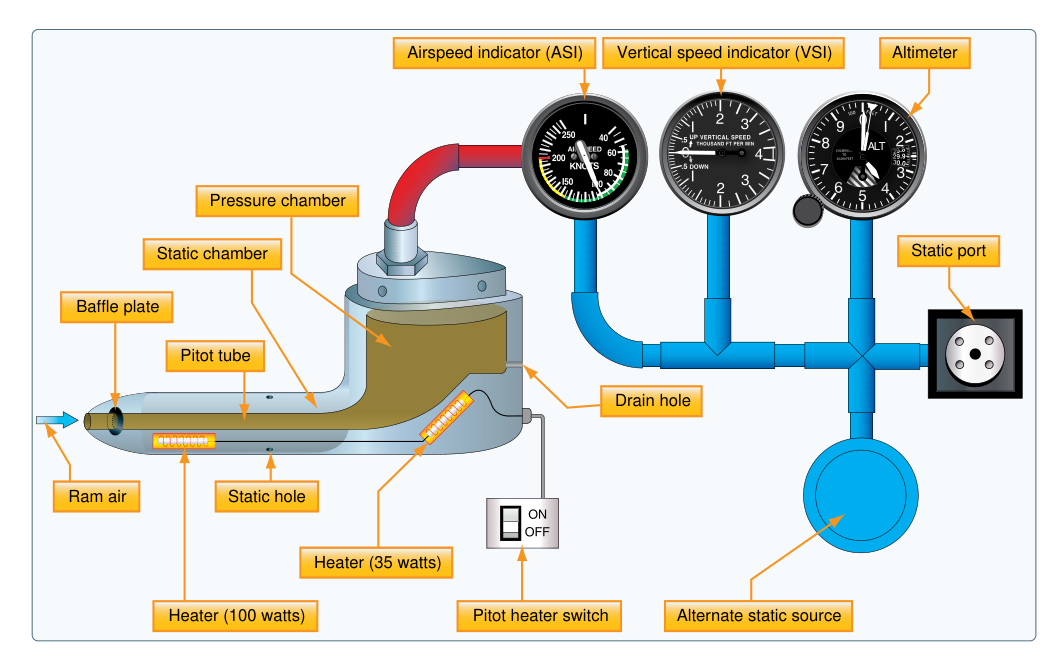
The static system is one of aviation's quiet workhorses. A tiny hole — or a network of holes — drilled into the fuselage skin samples the ambient atmospheric pressure outside the airplane. Three of your most important flight instruments depend on that sample: the altimeter, the vertical speed indicator (VSI), and the airspeed indicator (ASI). When that small opening becomes blocked by ice, tape left on during maintenance, insects, or heavy rain, all three instruments are affected simultaneously — and in ways that can be misleading if you don't understand the underlying physics. Knowing exactly what happens, and why, gives you the situational awareness to recognize the failure quickly and fly the airplane safely to resolution.
This article explains the mechanics of each instrument's failure, the real-world hazards those failures create, the key numbers and regulations you'll need for the FAA knowledge test, and the practical steps a pilot takes when blockage is suspected.
How the Static System Works
The static port connects via tubing to the low-pressure (reference) side of each pitot-static instrument. In a standard light trainer the static port is flush-mounted on one or both sides of the fuselage near the aft cabin. Some aircraft have an alternate static source inside the cockpit, which samples cabin air and can be selected if the primary port becomes blocked.
When the airplane is in level unaccelerated flight, the static port samples air that is very close to the true ambient atmospheric pressure at that altitude. As the airplane climbs, ambient pressure decreases; as it descends, pressure increases. The instruments translate those pressure changes into meaningful readings. Remove the ability to track those pressure changes — by blocking the port — and each instrument reacts according to its own internal design.
Instrument-by-Instrument Failure Analysis
Altimeter
The altimeter contains a sealed aneroid wafer (an evacuated metal capsule) that expands and contracts with changing ambient pressure. The static port connects to the case surrounding that wafer, not to the wafer itself. When ambient pressure in the case changes, the wafer deflects relative to the case, and gears translate that deflection into an altitude reading.
If the static port is blocked, the pressure inside the altimeter case is frozen at whatever value it held when the blockage occurred. The aneroid wafer sees no change in reference pressure, so it does not deflect — and the altimeter displays the altitude at the moment of blockage, no matter where the airplane goes afterward. Climb 2,000 feet above the blockage point, and the altimeter still reads the old altitude. Descend, and the same thing happens. The reading is simply stuck.
The danger is subtle: if the blockage occurs in cruise at a given altitude, the instrument looks perfectly normal at first. It's only when the pilot climbs or descends that the error becomes apparent — and by then the pilot may already be at an altitude significantly different from what the instrument displays.
Vertical Speed Indicator (VSI)
The VSI measures the rate of pressure change rather than absolute pressure. It works by routing static pressure to both the inside of a diaphragm and — through a calibrated metering leak — the surrounding case. The case pressure lags behind the diaphragm pressure as altitude changes, and that differential deflects a pointer to show climb or descent rate.
With the static port blocked, no new pressure can enter or exit the instrument. The calibrated leak quickly equalizes pressure inside the diaphragm and the surrounding case. The result: the VSI reads zero — indicating level flight — regardless of the actual pitch attitude or trajectory of the airplane. This is dangerous because a pilot who does not scan other instruments might believe the airplane is maintaining altitude when it is actually in a gradual climb or descent.
Airspeed Indicator (ASI)
The ASI is slightly more complex because it uses two pressure inputs: pitot (ram air) pressure on one side of an internal diaphragm, and static pressure on the other side. The difference between pitot and static pressure — called dynamic pressure — represents airspeed. The static port feeds the case surrounding the diaphragm, while the pitot tube feeds directly into the diaphragm.
When the static port blocks, the reference pressure in the ASI case is frozen. Pitot pressure, however, continues to change with the airplane's flight path. As the airplane climbs with a blocked static port, ambient pressure decreases but the static side of the ASI is stuck at a higher (lower-altitude) pressure. That makes the pressure differential appear smaller than it really is, so the ASI under-reads — it shows less airspeed than actually exists. Conversely, if the airplane descends, ambient pressure rises but the static reference is still frozen at a lower (higher-altitude) pressure, making the differential appear larger than reality, so the ASI over-reads — it shows more airspeed than actually exists.
Remember the pattern: climb → ASI under-reads; descend → ASI over-reads. During a descent with a blocked static port, an ASI that reads dangerously high may tempt a pilot to reduce power and pitch up — but the actual airspeed may be well within normal limits. Conversely, during a climb the pilot might push the nose down to regain what appears to be lost airspeed, when airspeed is actually fine.
Why It Matters — Real-World Hazards
Static port blockage is most hazardous during instrument meteorological conditions (IMC), where the pilot depends entirely on instruments. A frozen altimeter gives no terrain clearance information; a zeroed-out VSI provides no rate awareness; and a misleading ASI can cause inappropriate power or pitch changes. The combination of all three failing at once — while appearing to give readings — is arguably more dangerous than an instrument going completely dark, because the pilot must recognize the subtle inconsistency rather than responding to an obvious failure.
Even in visual conditions, blockage during approach can be deadly. An ASI that over-reads during a descending approach may show an apparently comfortable speed while the airplane is actually approaching a stall. This is precisely why pre-flight checks of static ports are mandatory — a piece of masking tape forgotten after a wash, a mud dauber's nest, or ice formed in freezing fog can all block the port before flight.
The Alternate Static Source
Most training aircraft are equipped with an alternate static source, typically a valve in the cockpit that opens the static system to cabin air. Cabin pressure is generally slightly lower than ambient outside pressure (because airflow over the fuselage creates a venturi-like suction effect at the static source location), so when the alternate source is activated:
- The altimeter reads slightly higher than actual altitude (because cabin pressure is lower, suggesting a higher altitude to the altimeter).
- The ASI reads slightly higher than actual airspeed for the same reason.
- The VSI may briefly show a climb as the system transitions to the new lower-pressure source, then stabilizes.
The Pilot's Operating Handbook (POH) for your specific aircraft will contain correction tables for alternate static source errors. In an emergency, however, the slight inaccuracies of the alternate source are far preferable to three frozen instruments.
Key Numbers and Rules
- Three instruments affected: altimeter, VSI, and ASI — all simultaneously when the static port blocks.
- Altimeter: freezes at the altitude where blockage occurred; error equals the entire altitude change since blockage.
- VSI: reads zero (appears level) regardless of actual vertical movement.
- ASI during climb: under-reads (shows less than actual airspeed).
- ASI during descent: over-reads (shows more than actual airspeed).
- Pitot tube blockage only: affects ASI alone; does not affect altimeter or VSI because those instruments use only the static side.
- Alternate static source: introduces slight positive errors in altitude and airspeed readings; consult the POH correction card.
- Preflight check: 14 CFR Part 91 and standard preflight checklists require pilots to check that static ports are clear and unobstructed before each flight.
Common Test Traps
- Confusing pitot blockage with static blockage. A blocked pitot tube affects only the ASI. A blocked static port affects the altimeter, VSI, and ASI together. If a question says all three pitot-static instruments are affected, the problem is with the static system, not the pitot tube.
- Getting the ASI direction wrong. Students often memorize that blockage causes errors but mix up which direction. Always anchor the logic: blocked static freezes the reference; if you climb, ambient pressure drops below the frozen reference, shrinking the differential — so the ASI under-reads. Descent does the reverse.
- Assuming the VSI shows an error, not zero. The VSI does not show the wrong rate — it shows zero. This distinction matters because a zero reading looks plausible and won't trigger alarm as quickly as a wildly wrong number would.
- Forgetting that alternate static introduces its own errors. The FAA will sometimes ask what happens to instrument readings after switching to alternate static. The answer is not "they return to normal" — the altimeter and ASI will read slightly high due to lower cabin pressure.
- Thinking the altimeter gradually drifts. With a blocked static port, the altimeter does not slowly drift upward or downward — it freezes instantly and stays at exactly the reading it had when blockage occurred. Any apparent gradual change would suggest another problem entirely.