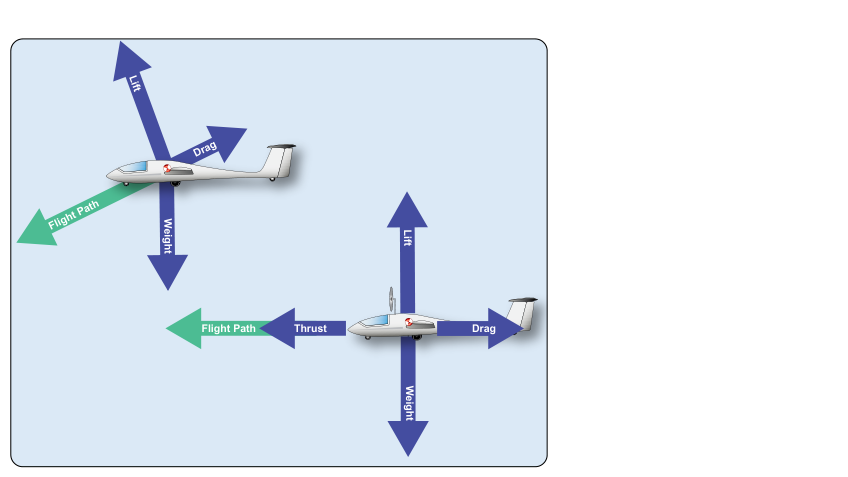
Before a pilot can master an aircraft, they must understand the invisible forces acting on it at every moment. Four fundamental forces govern all powered, fixed-wing flight: lift, weight, thrust, and drag. These forces do not act independently — they interact continuously, and it is the relationship among them that determines everything from a routine cruise to a stall recovery. Understanding how each force is generated, what increases or decreases it, and how they pair against each other is foundational knowledge for the FAA knowledge test and, more importantly, for sound airmanship.
Think of the four forces as two opposing pairs. Lift opposes weight (the vertical pair), and thrust opposes drag (the horizontal pair). In steady, level, unaccelerated flight — what the FAA calls straight-and-level unaccelerated flight — all four forces are in equilibrium: lift equals weight, and thrust equals drag. Any time one force changes, the others must be managed to restore balance or to intentionally change the aircraft's flight path.
Lift: The Upward Force
Lift is the aerodynamic force that acts perpendicular to the relative wind and supports the aircraft in flight. It is generated primarily by the wings, though other surfaces (such as the horizontal stabilizer) contribute smaller amounts. Lift is produced by two complementary effects: the pressure difference between the upper and lower wing surfaces (explained by Bernoulli's principle) and the deflection of airflow downward by the wing (Newton's third law). Neither explanation alone is complete — both mechanisms contribute to total lift.
The lift equation tells us what controls lift: L = CL × ½ρV² × S, where CL is the coefficient of lift (driven primarily by angle of attack), ρ is air density, V is airspeed, and S is wing area. In practical terms, a pilot controls lift mainly through angle of attack (AOA) and airspeed. Increasing AOA increases lift — up to the critical angle of attack, beyond which the wing stalls. Doubling airspeed quadruples lift (because of the V² relationship), which is why small speed changes have large lift effects.
Air density also matters enormously. On a hot, high-altitude day (high density altitude), the air is thin, and the wing must work harder — requiring a higher true airspeed or a greater AOA — to generate the same lift. This is why performance degrades at high-elevation airports on warm days.
Weight: The Downward Force
Weight is the force of gravity acting on the aircraft — the total mass of the airframe, fuel, crew, passengers, and cargo, pulled toward the center of the Earth. Unlike the other three forces, weight is always directed straight down and does not depend on airspeed or attitude. Weight acts through the aircraft's center of gravity (CG), the point where the total weight is considered to be concentrated.
CG location is critical. If the CG is too far forward, the nose is heavy and the aircraft requires a strong up-elevator force to maintain level flight, increasing drag and reducing maneuverability. If the CG is too far aft, the aircraft becomes longitudinally unstable and may be impossible to recover from a stall. The FAA mandates that aircraft are flown within the approved CG envelope, which is why weight-and-balance calculations are a pre-flight requirement, not just a paperwork formality.
During a level banked turn, the lift vector tilts with the wings, so its vertical component decreases. To maintain altitude, the pilot must increase total lift — typically by increasing back pressure — which effectively increases the load on the aircraft. This is why load factor (measured in Gs) increases in turns: a 60° bank requires the wings to support twice the aircraft's weight (2 Gs).
Thrust: The Forward Force
Thrust is the forward force produced by the powerplant — the engine and propeller working together (or a jet engine) — that overcomes drag and accelerates the aircraft. The propeller accelerates a large mass of air rearward; by Newton's third law, an equal and opposite reaction pushes the aircraft forward.
Thrust is not always aligned perfectly with the aircraft's flight path. On many single-engine propeller aircraft, the thrust line is slightly offset to counteract propeller-induced effects (such as P-factor and torque). Pilots experience these as left-turning tendencies at high power and low airspeed — the classic scenario on takeoff rotation or in a power-on stall.
It is important to understand that thrust and lift together support the aircraft — in a climb, for example, the thrust vector has a component that helps support weight, while the lift vector is not quite perpendicular to the flight path in the same way as in level flight. The FAA discusses this in the context of how climbs, descents, and turns each shift the balance among the four forces.
Drag: The Rearward Force
Drag is the aerodynamic force that acts parallel to and in the same direction as the relative wind — in other words, it opposes the motion of the aircraft. There are two primary categories of drag:
- Parasite drag — caused by the physical form of the aircraft pushing through the air. It includes form drag (shape resistance), skin friction drag, and interference drag where airflows meet. Parasite drag increases with the square of airspeed: double the speed, and parasite drag quadruples.
- Induced drag — a byproduct of lift production. When a wing generates lift, wingtip vortices form, and the pressure differential between the upper and lower surfaces creates a rearward-acting force. Induced drag is highest at low airspeeds and high angles of attack — the opposite behavior of parasite drag. This is why slow flight and stalls involve high induced drag.
Total drag is the sum of parasite and induced drag. At some intermediate airspeed — the point where induced and parasite drag are equal — total drag is at its minimum. This is the airspeed for best glide and, for a propeller aircraft, approximates the speed for maximum range. Flying faster than this point increases parasite drag; flying slower increases induced drag — in both cases, total drag rises.
The Four Forces in Different Phases of Flight
Understanding how the forces interact across different flight conditions helps connect theory to the cockpit:
- Takeoff roll: Thrust exceeds drag; as speed builds, lift rises until it exceeds weight and the aircraft becomes airborne.
- Steady climb: Thrust exceeds drag; lift is slightly less than weight because the thrust vector contributes a component supporting the climb.
- Straight-and-level cruise: All four forces are in equilibrium — lift equals weight, thrust equals drag.
- Descent: Thrust is reduced; drag and a component of weight along the flight path act to pull the nose down. Lift is slightly less than weight.
- Landing flare: Power is reduced to idle; drag assists in slowing the aircraft, and the pilot uses back pressure to increase AOA, trading airspeed for lift to cushion touchdown.
Key Numbers and Rules
- Lift varies with the square of airspeed: double the speed → four times the lift (and four times the parasite drag).
- The critical angle of attack for most general aviation wings is approximately 15–20°; exceeding it causes a stall regardless of airspeed or attitude.
- A 60° banked level turn produces a load factor of 2.0 Gs, effectively doubling the aircraft's weight requirement on the wings.
- Minimum total drag occurs where induced drag equals parasite drag — this speed corresponds to best-glide speed (VG) in the POH.
- High density altitude reduces air density, which reduces lift, thrust, and increases the true airspeed needed for flight — all three degrade simultaneously.
- Weight acts through the CG; if CG is outside the approved envelope, the aircraft may be uncontrollable.
Common Test Traps
- Stalls are about angle of attack, not airspeed. A stall occurs when the critical AOA is exceeded — you can stall at any airspeed, any attitude, and any power setting. The FAA test frequently presents accelerated stalls to test this understanding.
- In a level turn, lift must increase, not just redirect. Students often say the lift vector tilts to turn the aircraft, but forget that the vertical component must still equal weight — requiring total lift to increase above the straight-and-level value.
- Thrust does not equal lift in a climb. In a steady climb, lift is less than weight; thrust partially supports the aircraft weight. This is a common misconception the test exploits.
- Induced drag and airspeed are inversely related. Many students assume all drag increases with speed. Induced drag actually decreases as airspeed increases — this distinction drives questions about slow flight hazards and best-glide speed.
- Doubling airspeed quadruples — not doubles — lift and parasite drag. The V² (velocity squared) relationship is a frequent source of wrong answers when students guess that effects are proportional rather than exponential.