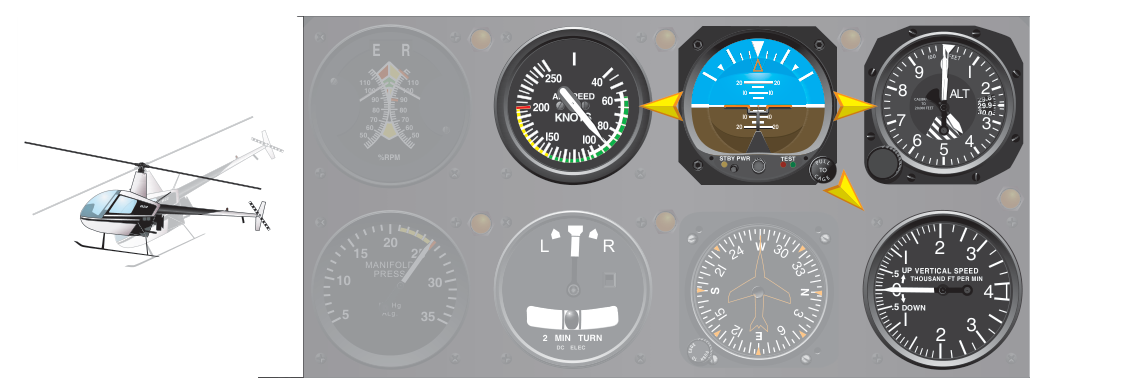
When a pilot transitions from flying by visual reference to flying solely by instruments, one of the most important conceptual shifts is learning to think in terms of primary and supporting (sometimes called secondary) instruments. Every instrument in the panel tells a story, but for any given flight condition — straight-and-level flight, a climb, a descent, or a turn — one instrument stands out as the most direct and reliable indicator of what the airplane is doing in that axis. For pitch control, understanding exactly which instrument is primary and which instruments play a supporting role is the foundation of the entire instrument scan. The FAA's Instrument Flying Handbook (FAA-H-8083-15) builds the entire attitude instrument flying system around this distinction, and it is tested heavily on the Instrument Rating knowledge exam.
This article explains the primary and supporting instrument concept for pitch, walks through each common flight condition, and gives you the practical cockpit insight to build a reliable, efficient scan.
The Primary and Supporting Instrument Concept
The attitude indicator is sometimes called the "master" instrument because it directly displays pitch and bank attitude. However, in the primary/supporting framework, the attitude indicator actually functions as the control instrument for pitch — it is what the pilot uses to set pitch attitude. Once a target attitude is established, other instruments reveal whether that attitude is producing the desired performance. This is the heart of the concept: control instruments show what the airplane is doing right now; performance instruments confirm whether the airplane is achieving the intended result.
Among the performance instruments, one is designated the primary instrument for any given condition. The primary instrument is the single most sensitive and direct indicator of whether performance in that axis is being maintained. If the primary pitch instrument shows what you want, your pitch attitude is correct. Supporting instruments back up the primary, provide trend information, and help diagnose the cause if the primary begins to deviate. They are not redundant clutter — they are part of a cross-check that catches errors before they grow.
Which Instrument Is Primary for Pitch?
The answer depends entirely on what the airplane is supposed to be doing. The FAA groups pitch-primary instruments by flight condition as follows:
Straight-and-Level Flight
During straight-and-level flight at a constant airspeed, the altimeter is the primary instrument for pitch. The altimeter directly measures whether your pitch attitude is holding the airplane at the assigned altitude. If the altimeter is steady, your pitch is correct; if it drifts, pitch correction is needed. The attitude indicator tells you approximately where the miniature aircraft is relative to the horizon, but the altimeter confirms with authority whether that pitch attitude is actually keeping you level. Supporting pitch instruments in this condition include the vertical speed indicator (VSI), which shows the rate at which altitude is being gained or lost, and the airspeed indicator, which changes with pitch attitude — if pitch creeps up, airspeed will begin to fall, alerting the pilot even before a large altitude change appears on the altimeter.
Constant-Airspeed Climbs
During a stabilized, constant-airspeed climb, the airspeed indicator becomes the primary instrument for pitch. This surprises many students, but the logic is sound: in a climb, altitude is deliberately changing, so the altimeter is no longer a meaningful pitch reference. What defines the correct pitch attitude in a constant-airspeed climb is maintaining the target climb airspeed — too high a pitch and the airspeed bleeds below the target, too low and the airspeed rises above it. The VSI and attitude indicator serve as supporting instruments; the VSI shows the rate of climb being achieved, and the attitude indicator gives a quick reference to confirm the approximate nose-up angle.
Constant-Airspeed Descents
By the same logic, during a constant-airspeed descent, the airspeed indicator is again the primary instrument for pitch. Altitude is intentionally decreasing, so the altimeter cannot serve as the fixed reference. Maintaining the target descent airspeed is what defines correct pitch. The VSI supports by showing descent rate; the attitude indicator supports by showing the approximate pitch-down attitude, and the altimeter counts down toward the target level-off altitude — but none of these is primary for pitch while the descent is in progress.
Constant-Rate Climbs and Descents
A slightly different flight condition arises during constant-rate climbs and descents, such as the 500 ft/min or 1,000 ft/min climbs and descents common in IFR operations. Here, the goal is to maintain a specified rate rather than a specified airspeed (though both matter). In this condition, the vertical speed indicator is the primary pitch instrument because it directly measures whether the desired rate is being achieved. The airspeed indicator and altimeter shift to supporting roles — airspeed confirms that the pitch attitude is reasonable and not creating an energy management problem, while the altimeter counts progress toward the clearance altitude.
The Supporting Cast: VSI, Airspeed Indicator, and Altimeter
Each supporting instrument brings something unique to the cross-check:
- Vertical Speed Indicator (VSI): Shows the rate of altitude change. It has an inherent lag of approximately six to nine seconds, so it is a trend instrument, not an instantaneous one. It confirms that a pitch change is working, but you should not chase VSI fluctuations with large pitch inputs — small, smooth corrections are the instrument flying standard.
- Airspeed Indicator: Responds to pitch attitude changes relatively quickly and provides excellent trend information. In level flight, an unexpected airspeed change is an early warning of a pitch problem. In climbs and descents, it confirms the airplane is flying in a safe energy regime.
- Altimeter: The most direct readout of altitude achieved. In level flight it is primary; in climbs and descents it tells you how close you are to level-off or to a crossing restriction — but it is not the pitch-primary instrument while altitude is intentionally changing.
Why This Framework Matters in IMC
In actual instrument meteorological conditions (IMC), without external visual cues, the brain craves sensory input it can trust. Pilots who have not internalized the primary/supporting concept tend to develop an unstructured, wandering scan — darting from instrument to instrument without a hierarchy. This leads to fixation (staring at one instrument while another silently deviates), omission (skipping instruments entirely), and over-controlling (chasing every small needle wiggle). The primary/supporting framework gives the scan a logical anchor point: whatever condition you are flying, you know which instrument to return to most frequently. Cross-check the primary, note the supporting instruments, and make small corrections on the control instrument (attitude indicator) — this is the disciplined instrument pilot's rhythm.
Practically, this also matters during partial-panel operations. If the attitude indicator fails, identifying the primary performance instruments for pitch becomes even more critical, because the supporting instruments must now collectively paint the full pitch picture without the direct attitude reference. Knowing which instrument is primary for each condition tells you where to focus first when your control instrument is unavailable.
Key Numbers and Rules
- Straight-and-level: Altimeter is primary for pitch; VSI and airspeed indicator are supporting.
- Constant-airspeed climb: Airspeed indicator is primary for pitch; VSI and attitude indicator are supporting.
- Constant-airspeed descent: Airspeed indicator is primary for pitch; VSI and attitude indicator are supporting.
- Constant-rate climb or descent: VSI is primary for pitch; airspeed indicator and altimeter are supporting.
- VSI lag: Approximately 6–9 seconds; do not chase short-term VSI fluctuations with aggressive inputs.
- The attitude indicator is always the control instrument for pitch — it is used to set attitude, not to confirm performance.
- The concept of primary/supporting applies independently to pitch, bank, and power — never confuse the pitch-primary instrument with the bank-primary or power-primary instrument in your scan.
Memory Aid
A simple phrase that helps lock in the pitch-primary logic: "Level = Altimeter, Speed = Airspeed, Rate = VSI." Read it left-to-right: if you are flying level, the altimeter is primary. If you are climbing or descending at a target airspeed, the airspeed indicator is primary. If you are climbing or descending at a target rate, the VSI is primary. This three-part phrase covers every standard pitch condition on the instrument rating practical test.
Common Test Traps
- Confusing control and primary performance instruments: The attitude indicator is the control instrument, not the primary performance instrument for pitch. A common wrong answer is to call the attitude indicator the "primary" pitch instrument during level flight — it is not; the altimeter is.
- Mixing up constant-airspeed vs. constant-rate conditions: Many students reflexively answer "airspeed indicator" for any climb or descent question. In a constant-rate climb or descent, the VSI is primary — read the question carefully to see which type of maneuver is described.
- Treating the VSI as an instantaneous indicator: Because the VSI lags, the FAA tests whether you understand it is a trend instrument. Do not select it as the primary instrument for a condition where an immediate, precise readout is required.
- Forgetting that supporting instruments shift roles: In straight-and-level flight the airspeed indicator is supporting for pitch; in a constant-airspeed climb it becomes primary. The same instrument can hold different roles in different conditions — be ready for scenario-based questions that exploit this.
- Over-correcting based on supporting instruments: A test scenario may describe a pilot making large pitch changes to chase VSI fluctuations during level flight. Recognize this as improper technique — small, smooth corrections anchored to the primary instrument (altimeter) are correct.