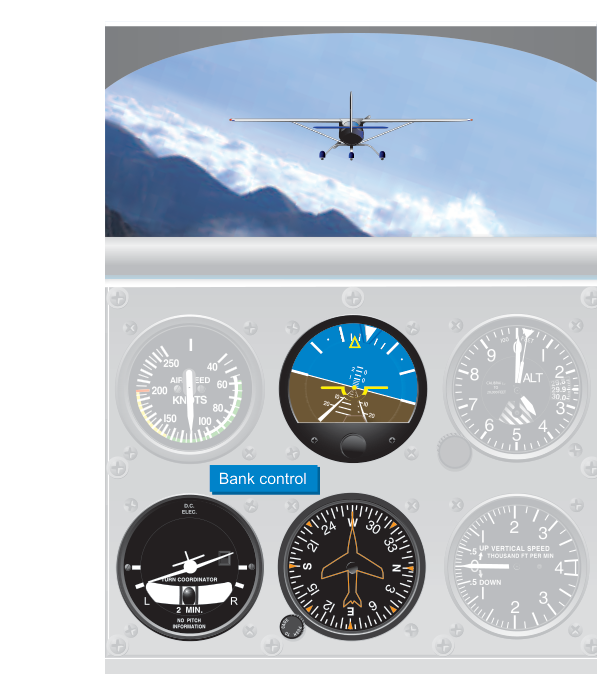
One of the foundational skills of instrument flying is knowing exactly which gauge to trust at any given moment. When the visual horizon disappears inside a cloud, your eyes need a clear hierarchy to follow — not a confusing scan of six instruments all demanding equal attention. The FAA's system of primary and supporting instruments gives you that hierarchy. Understanding it prevents fixation, reduces workload, and produces the precise, coordinated flight that instrument flying demands. Nowhere is this more important than in bank control, where even a small, uncorrected roll can quietly develop into a graveyard spiral.
This article covers how the primary/supporting concept works specifically for bank, which instrument holds which role in each phase of flight, and why the distinction matters both on the FAA Instrument Rating knowledge test and in the actual IFR environment.
The Primary and Supporting Concept Explained
The FAA Instrument Flying Handbook (FAA-H-8083-15) describes two overlapping methods of instrument interpretation: the control and performance method and the primary and supporting method. The primary/supporting method is the one that directly answers the question, "Which instrument do I read for each parameter right now?"
For any given flight parameter — pitch, bank, or power — one instrument at a time is designated the primary instrument. The primary instrument is the one that gives the most direct, most sensitive, and most immediate indication of that parameter. If you are trying to maintain a specific bank angle, the primary instrument is the one that will immediately show any deviation from that angle. All other instruments that reflect bank indirectly or less precisely are called supporting instruments. They confirm, cross-check, and provide context, but they are not the instrument you use to detect and correct a deviation in real time.
Critically, the designation of primary and supporting changes depending on what the airplane is doing. A straight-and-level cruise, a standard-rate turn, and a roll-out all have different primary bank instruments. Getting this right is not just academic — it shapes where your eyes go and how quickly you catch and correct deviations.
The Attitude Indicator: The Core Bank Reference
For turn entry and roll-out — any time you are establishing a bank angle or returning to wings-level — the attitude indicator (AI) is the primary instrument for bank. The AI gives you a direct, real-time, gyroscopically-stabilized representation of the aircraft's actual bank angle relative to the horizon. When you roll five degrees right, the AI miniature wings tilt five degrees right immediately. No other instrument responds this quickly or this directly to bank changes.
The AI is also the instrument you use during the entry into a turn and during roll-out from a turn, whenever you are establishing or returning from a bank angle. If your task is to roll into a 25-degree bank for a standard-rate turn, the AI tells you precisely whether you are at 25 degrees. Once the turn is established at a constant rate, however, the primary bank reference shifts — as explained below — to the heading indicator, since the AI's exact bank angle for a given turn rate varies with airspeed and can no longer serve as a fixed, direct reference.
The Heading Indicator: Primary for Bank During an Established Turn
Here is where many students get tripped up: the primary bank instrument is not always the AI. Per the Instrument Flying Handbook's primary/supporting tables, the attitude indicator is primary for bank during turn entry and rollout, and during straight-and-level flight. But once a turn is established at a constant rate — such as a standard-rate turn — the heading indicator (HI) becomes the primary instrument for bank, because the changing heading directly reflects whether the bank angle is producing the desired turn rate. The AI's indicated bank angle for a given turn rate changes with airspeed, so it cannot serve as the fixed reference once the turn is established; the HI's rate of heading change becomes the more direct indication of correct bank.
During roll-out, the AI again becomes primary for bank as you return the wings to a level or new target attitude, while the heading indicator becomes primary for heading, confirming that you stop the turn at the desired heading. The turn coordinator is never designated as the primary bank instrument in any standard phase of flight — it always serves a supporting role, cross-checking rate of turn and confirming the AI and HI indications.
Supporting Instruments for Bank
While the attitude indicator and heading indicator share the primary bank role depending on phase of flight, several other instruments serve as vital supporting references:
- Turn Coordinator: Indicates the rate of turn, which is a direct consequence of bank angle. If the AI shows wings-level but the turn coordinator shows a deflection, something is wrong — either the AI is precessing or you have a coordination problem. The turn coordinator also contains a slip/skid ball (inclinometer), which is the primary instrument for coordination (though not bank per se).
- Heading Indicator (Directional Gyro): During an established turn, the HI is the primary bank reference, showing whether you are turning at the correct rate. A bank angle that is too steep will produce a faster-than-expected heading change; too shallow will produce a slower one. During turn entry and roll-out, the HI supports the AI by confirming the turn's progress toward or away from a target heading.
- Magnetic Compass: Serves as a backup heading reference and, in the absence of a functional HI, can indirectly support bank awareness — though it is unreliable during turns due to acceleration, northerly turning, and dip errors.
- Altimeter and VSI: These are pitch instruments primarily, but an uncommanded altitude change during what should be level-bank flight can warn you that your bank has inadvertently changed and introduced a pitch component.
Phase-by-Phase Breakdown
Let's walk through common flight phases and identify the primary bank instrument clearly:
- Straight-and-level flight: Primary for bank = Attitude Indicator. Wings are level; the AI directly confirms zero bank. Supporting: turn coordinator (shows wings-level), heading indicator (heading is steady).
- Turn entry: Primary for bank = Attitude Indicator. You roll to the desired bank angle and read it directly off the AI. Supporting: turn coordinator (confirming rate developing), HI (confirming heading beginning to change).
- Established standard-rate turn: Primary for bank = Heading Indicator. Once the bank angle is set and the turn is constant, the HI's rate of heading change becomes the direct reference for correct bank, since the AI's exact bank angle for a given rate varies with airspeed. Supporting: attitude indicator (bank angle reference), turn coordinator (confirms 3°/sec rate).
- Roll-out to a heading: Primary for heading = Heading Indicator; primary for bank = Attitude Indicator (returning to zero bank). Supporting: turn coordinator (rate decreasing to zero), HI (heading approaching target).
- Wings-level after roll-out: Primary for bank = Attitude Indicator (shows zero bank). Supporting: turn coordinator and HI confirm steady heading.
Why This Matters: Safety and Practical Application
The primary/supporting framework exists because human beings under stress tend to fixate. Without a deliberate system telling you which instrument to prioritize, you might stare at the altimeter when what you really need to catch is a developing bank. This fixation problem is directly linked to one of the deadliest IFR accidents: spatial disorientation leading to a graveyard spiral. In a graveyard spiral, the aircraft rolls progressively steeper, the pilot senses only a descent (not a bank), and the altimeter unwinds rapidly. A disciplined pilot who correctly identifies the primary bank instrument for the current phase of flight — the AI during turn entry and roll-out, the HI during an established turn — and cross-checks it on a regular scan cycle will catch the bank deviation long before it becomes a spiral.
The FAA emphasizes that an effective instrument scan is not random eye movement — it is a purposeful, logical pattern that always returns to the primary instrument for each parameter. Knowing which instrument is primary for bank in each phase keeps your scan anchored.
Key Numbers and Rules
- A standard-rate turn is 3 degrees per second, producing a 360-degree turn in 2 minutes.
- Standard-rate bank angle approximation: airspeed (knots) ÷ 10 + 7 (e.g., at 100 knots ≈ 17 degrees of bank).
- The turn coordinator miniature aircraft deflects to indicate standard rate — the L and R marks represent standard-rate turns, not bank angle directly.
- Begin roll-out from a turn approximately one-half the bank angle before the target heading (e.g., at 20 degrees of bank, start rolling out 10 degrees before the desired heading).
- The attitude indicator is gyroscopically driven and subject to precession errors — always cross-check against the turn coordinator to detect AI failure.
- During turn entry and roll-out, the AI provides immediate bank information; once a turn is established at a constant rate, the heading indicator's rate of change becomes the primary reference, with the turn coordinator providing rate-of-turn confirmation.
Memory Aid
A useful way to remember the role of each instrument is to think in terms of phase of flight: during turn entry and roll-out, the AI is your direct bank reference — it reacts instantly to what the wings are doing. Once a turn is established at a constant rate, the HI becomes your direct bank reference, since its rate of heading change tells you whether the bank angle is correct. The turn coordinator always plays a confirming role, cross-checking rate of turn against whichever instrument is currently primary. If the primary and confirming instruments disagree, suspect instrument failure and apply partial-panel procedures.
Common Test Traps
- Confusing the turn coordinator's function: The turn coordinator indicates rate of turn, not bank angle, and it is never the primary bank instrument in any standard phase of flight — it is always a supporting instrument. Students who mix this up will choose wrong answers on knowledge test questions asking which is