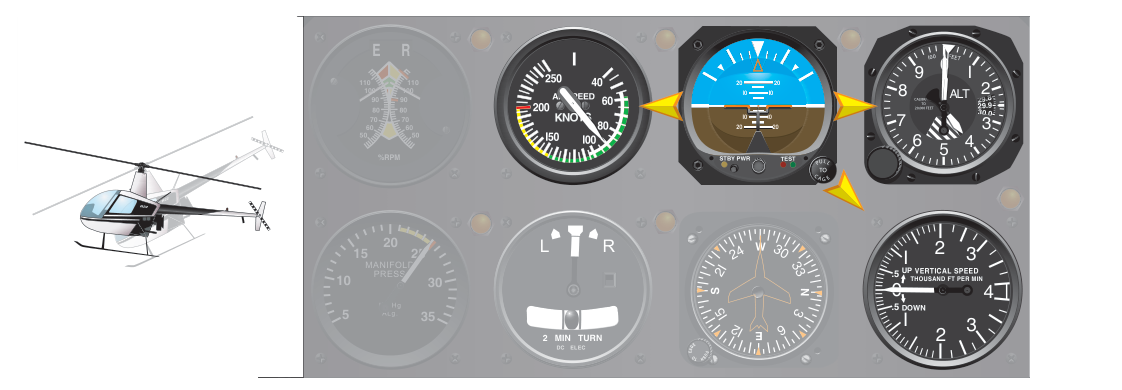
The vertical speed indicator (VSI) is one of the most misunderstood instruments in the cockpit. Student pilots learning to fly on instruments often make a classic mistake: they stare at the VSI, wait for it to move, then react to what they see — and the result is a roller-coaster ride of overcorrections. To fly precisely under instrument flight rules (IFR), you must understand exactly what the VSI is telling you, when it tells you, and how it fits into the broader scan. The short answer is that the VSI is a trend instrument, not a control reference instrument. It tells you where you are going, not where you are.
This article breaks down the physics behind VSI lag, how to correctly interpret trend information during attitude instrument flying, how the VSI fits into the instrument cross-check, and — critically — what errors the FAA knowledge test is designed to expose about pilots who misuse this gauge.
How the Vertical Speed Indicator Works
The VSI is a differential pressure instrument. It connects to the static pressure system and measures the difference between static pressure inside a calibrated leak (called a metering unit or capillary) and the ambient static pressure outside it. When the aircraft is in level flight, both pressures equalize and the pointer reads zero. When the aircraft climbs, ambient static pressure decreases faster than the pressure inside the leak can bleed off, creating a pressure differential that deflects the pointer upward. When the aircraft descends, the opposite occurs.
The key word is leak. Because pressure must bleed through a tiny orifice to equalize, there is an inherent time delay between the moment the aircraft's pitch attitude changes and the moment the VSI reflects a stabilized rate. This delay is typically a few seconds — long enough to be dangerous if you are relying on the VSI as your primary pitch reference. During that time, the aircraft can be well established in an unwanted climb or descent before the needle catches up.
Instantaneous Versus Trend VSIs
Some aircraft are equipped with an instantaneous vertical speed indicator (IVSI), which incorporates small accelerometer pumps that detect vertical acceleration immediately and artificially move fluid to pre-position the needle before the normal capillary lag would allow it to settle. The IVSI dramatically reduces lag, but it introduces a different quirk: it momentarily deflects the needle in response to turbulence or pitch inputs even when the actual vertical speed has not changed. Standard VSIs found in most training aircraft do not have this feature, so lag management is essential.
Trend Information: What the VSI Really Tells You
Because of its lag, the VSI is classified in the FAA's instrument flying methodology as a trend instrument for pitch. The three categories of instrument information are:
- Control instruments — show the direct result of control inputs (attitude indicator, power instruments). Used to establish and set attitudes.
- Performance instruments — show the actual aircraft performance (altimeter, airspeed indicator, VSI, heading indicator). Used to verify the result of control inputs.
- Navigation instruments — show deviation from a course (VOR, ILS, GPS). Used for course tracking.
The VSI is a performance instrument, but within that category it serves a special trend function. The altimeter shows you where you are in altitude right now. The VSI shows you which direction you are moving and at what rate — but with a delay. That delay makes it useful for catching trends early once you know how to interpret the initial needle movement, and it makes it dangerous if you wait for it to fully stabilize before reacting.
Here is the practical logic: when you establish a new pitch attitude on the attitude indicator, glance at the VSI. Within two to three seconds you will see the needle begin to swing. That initial movement is your trend cue — it tells you whether you are climbing, descending, or approaching level flight. Do not wait for the needle to stop moving. Cross-check the altimeter to confirm whether you are actually gaining or losing altitude, then return your scan to the attitude indicator to make fine corrections. The VSI validates your pitch attitude; it does not replace it.
The Instrument Scan and the VSI's Role
The FAA Instrument Flying Handbook describes several scanning techniques — the radial scan, the selective radial scan, and others. Regardless of the method, the attitude indicator remains the central reference instrument for pitch and bank control. The VSI is scanned as part of the pitch cross-check, alongside the altimeter and airspeed indicator.
A common error is fixation on the VSI. A pilot who locks onto the VSI while trying to maintain altitude will make pitch corrections based on lagged information. By the time the VSI shows a 200 fpm climb, the aircraft may already be 150 feet above the assigned altitude and the climb may be steepening. If the pilot then pushes forward to correct, the VSI will not respond for a few more seconds, during which the pilot may push even further — creating the classic porpoising oscillation that examiners watch for on instrument checkrides.
The disciplined approach is: control pitch with the attitude indicator, verify with the altimeter, use the VSI to observe trend. When established in level flight and the VSI reads zero consistently, you have confirmation that your pitch attitude on the AI is correct for level flight at that power setting. Any deviation from zero is an early warning to re-examine the AI.
Using the VSI During Climbs and Descents
The VSI is particularly valuable when establishing and leveling off from climbs and descents. During an instrument climb, the VSI should indicate your target rate of climb. When approaching your target altitude, the standard technique is to begin leveling off at approximately 10% of your climb rate above the target altitude. For example, if climbing at 500 fpm, begin your level-off 50 feet before the target altitude. The VSI will lag as you transition to level flight, so if you wait until the altimeter reads exactly your target altitude, you will overshoot.
During a descent, the same principle applies. Watch the VSI for trend — if it is showing an increasing rate of descent (needle moving further below zero), that is your cue to arrest the sink before the altimeter catches it. The VSI gives you a few seconds of warning that the altimeter does not.
Key Numbers and Rules
- VSI lag: a few seconds — standard in most piston training aircraft with conventional static system plumbing; the Instrument Flying Handbook describes this lag qualitatively rather than fixing it at a precise number of seconds.
- Standard rate of climb/descent for IFR procedures: 500–1,000 fpm unless otherwise specified, but specific procedures may call for obstacle clearance rates — always check the plate.
- Level-off lead point: approximately 10% of climb/descent rate — e.g., begin level-off 100 feet early when climbing at 1,000 fpm.
- VSI range: typically ±2,000 fpm on light aircraft; the needle pegs against the stop during steep unusual attitudes.
- Power failure — the VSI is a static-only instrument. It does not require pitot pressure or electrical power to operate, but a blocked static port will cause it to freeze or indicate erroneously.
- Alternate static source — when selected, air enters from inside the cabin (lower pressure than outside in most configurations), causing the VSI to momentarily spike downward even if the aircraft is in level flight, then settle at a slightly different reading.
Common Test Traps
- Treating the VSI as a control instrument. The FAA exam may describe a pilot making pitch corrections based on VSI readings alone. Recognize this as improper — the attitude indicator drives pitch control, and the VSI only verifies trends.
- Ignoring lag duration. Test questions often ask what happens when a pilot relies solely on the VSI to maintain altitude. The expected answer involves the lag causing overcorrections and altitude excursions — know that the VSI lags by a few seconds behind actual pitch changes.
- Confusing zero VSI with level flight. A VSI reading of zero only means rate of change is zero right now. You can be 500 feet off your assigned altitude with the VSI showing zero. Always cross-check the altimeter.
- Blocked static port effect on the VSI. A blocked static port traps pressure inside the capillary. The VSI will read zero regardless of actual vertical movement — it will not alert you to a climb or descent. The altimeter and airspeed indicator are also affected.
- Alternate static source calibration shift. If a question describes an alternate static source being selected, remember that the VSI will temporarily read incorrectly. This is a subtle but tested detail about static system quirks in instrument flight.
Mastering the VSI means accepting its limitations as features, not flaws. Its lag teaches you to fly ahead of the aircraft — to set an attitude, trim, and let the performance instruments confirm what you have already commanded. In the disciplined instrument pilot's scan, the VSI is a valued early-warning trend gauge, never a crutch. Fly the attitude indicator, verify with the altimeter, and let the VSI tell you which way the story is heading.