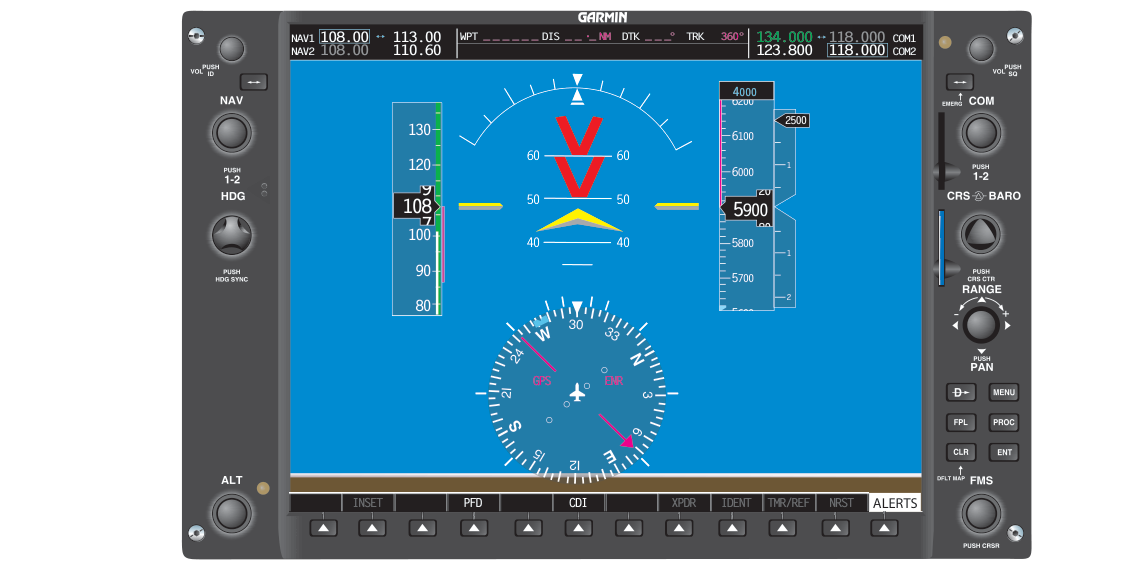
An unusual attitude is any aircraft pitch or bank configuration that is unexpected, unintended, or potentially hazardous — and one that the pilot did not consciously command. In instrument meteorological conditions (IMC), where outside visual references are absent, unusual attitudes can develop with startling speed. Spatial disorientation, fixation on a single instrument, turbulence, or a momentary lapse of attention can all allow the aircraft to depart significantly from controlled flight before the pilot realizes what is happening. Recovery must be immediate, deliberate, and guided entirely by the flight instruments. This article covers the causes, recognition, and correct recovery procedures for unusual attitudes — one of the most heavily tested and practically critical topics on the FAA Instrument Rating knowledge test and checkride.
How Unusual Attitudes Develop
The insidious nature of unusual attitudes is that they rarely announce themselves dramatically. In IMC, the vestibular system — the inner ear's sense of motion and balance — is easily deceived. The leans, graveyard spiral, and other vestibular illusions described in the FAA's Instrument Flying Handbook can convince a pilot that the aircraft is wings-level and in controlled flight when, in reality, it has entered a steep bank and dive. Once the pilot acts on these false sensations instead of trusting the instruments, the situation deteriorates rapidly.
Common causes of unusual attitudes include: fixation or preoccupation with a single instrument while neglecting others; turbulence that displaces the aircraft faster than the pilot can correct; attempting a maneuver at or beyond the pilot's personal proficiency limits; and transitioning abruptly from visual to instrument references without an orderly cross-check. Any of these can allow pitch and bank to diverge significantly from the intended flight path before the pilot is aware of the problem.
The Two Types of Unusual Attitudes
The FAA categorizes unusual attitudes into two broad types, each requiring a different initial recovery action: nose-high (climbing) unusual attitudes and nose-low (diving) unusual attitudes. Understanding the distinction is essential because applying the wrong initial action to the wrong type can make the situation far worse.
Nose-High Unusual Attitude
A nose-high unusual attitude is characterized by an excessive pitch-up attitude, often accompanied by a rapidly decreasing airspeed, an increasing altimeter, and a climbing vertical speed indicator. If not corrected promptly, the aircraft will approach a stall. The bank may be wings-level or banked in any direction. The key instrument clues are: airspeed decreasing toward or below the stall speed range, altimeter unwinding upward, and the attitude indicator showing a nose-high pitch.
Nose-Low Unusual Attitude
A nose-low unusual attitude involves a dangerously steep dive, often combined with an increasing bank. The instruments will show rapidly increasing airspeed (possibly approaching Vne, never-exceed speed), a rapidly unwinding altimeter (altitude is being lost fast), and a high rate of descent on the vertical speed indicator. This type is typically more immediately dangerous because of the rate at which energy builds and altitude is lost. A nose-low unusual attitude with a steep bank is the classic graveyard spiral, and it is the scenario that has caused many fatal accidents.
Recognition: The Instrument Cross-Check
Proper recognition depends on an active, disciplined instrument cross-check. Rather than staring at a single instrument, the instrument pilot scans all primary instruments systematically. When an unusual attitude has developed, the instruments will collectively paint an unmistakable picture:
- Attitude Indicator (AI): Shows the pitch and bank angle directly. This is the first instrument to check when disorientation is suspected.
- Airspeed Indicator (ASI): Rapidly decreasing airspeed signals a nose-high attitude; rapidly increasing airspeed signals a nose-low attitude.
- Altimeter: Rising altitude confirms a climb (nose-high); rapidly falling altitude confirms a descent (nose-low).
- Vertical Speed Indicator (VSI): Confirms the rate and direction of altitude change.
- Turn Coordinator / Heading Indicator: Reveals whether the aircraft is also turning or in a bank.
- Tachometer / Engine Instruments: Overspeed conditions in a nose-low attitude may produce unusual engine readings and sound cues.
The Instrument Flying Handbook emphasizes that the attitude indicator is the primary instrument for recognizing an unusual attitude because it directly depicts pitch and bank. However, because the AI is gyroscopic and can tumble if the pitch or bank limits of the instrument are exceeded, pilots must be prepared to cross-check with the other instruments to confirm what they are seeing.
Recovery Procedures
The FAA-prescribed recovery procedures differ for nose-high and nose-low unusual attitudes. Both require the pilot to act in the correct sequence to restore controlled flight safely.
Nose-High Recovery
The priority in a nose-high recovery is to prevent the impending stall. The correct sequence is:
- Power — Increase: Apply full or maximum available power. This adds thrust to help prevent further airspeed loss and aids in pitching the nose toward level flight.
- Pitch — Lower: Simultaneously or immediately after adding power, apply forward pressure on the controls to reduce the pitch attitude toward the horizon on the attitude indicator.
- Bank — Level: Roll the wings to level using the attitude indicator and turn coordinator as references. Levelingthe wings allows all lift to act against gravity rather than causing the aircraft to turn.
The memory phrase taught by many instructors is Power, Pitch, Bank for the nose-high recovery. The goal is to break the stall onset, restore flying speed, and stop any unintended turn — all before significant altitude is lost.
Nose-Low Recovery
The nose-low recovery is considered the more critical of the two because the aircraft is accelerating toward potentially destructive speeds and losing altitude rapidly. The correct sequence is:
- Power — Reduce: Immediately reduce power to idle or as needed. Adding power in a nose-low dive would only accelerate the aircraft further toward Vne and increase structural load during the pull-out.
- Bank — Level: Roll the wings level first, before pulling back on the controls. This is the step pilots most often get wrong under pressure. Pulling back while in a steep bank causes the aircraft to follow a circular arc rather than recovering toward level flight, dramatically increasing the load factor (G-force). At steep bank angles, the stall speed rises significantly, and overstressing or stalling the aircraft during the pull is a real danger.
- Pitch — Raise: Once the wings are level (or nearly so), smoothly and firmly apply back pressure to raise the nose to the horizon. Monitor the airspeed and altimeter throughout.
The memory sequence for nose-low is Power, Bank, Pitch — the opposite order of pitch and bank compared to the nose-high recovery. Confusing these two sequences is one of the most dangerous knowledge-test and checkride errors.
Why It Matters: Safety Consequences
Loss of control in flight (LOC-I) is consistently one of the leading causes of fatal aviation accidents, and a significant proportion involve pilots who entered IMC without the skills to recover from unusual attitudes. The graveyard spiral — a nose-low, banked unusual attitude — can take an aircraft from controlled flight to structural failure or ground impact in well under a minute if not corrected promptly. Spatial disorientation compounds the problem: a pilot may feel that the recovery inputs are wrong even while the instruments clearly show the aircraft is returning to normal flight. Trusting the instruments over physical sensations is the discipline that separates instrument-rated pilots from those who are not.
Key Numbers and Rules
- Nose-high recovery order: Power up → Pitch down → Bank level.
- Nose-low recovery order: Power off → Bank level → Pitch up.
- Load factor in a 60° bank: 2 Gs — stall speed increases by approximately 41% over wings-level stall speed. Pulling while steeply banked is structurally and aerodynamically dangerous.
- Attitude indicator limits: Many traditional gyroscopic AIs tumble (lose accuracy) if pitch exceeds approximately 60–70° or bank exceeds 100–110°. In an extreme unusual attitude, pilots may need to rely primarily on the turn coordinator, airspeed, and altimeter.
- Vne and Va: In a nose-low unusual attitude, if airspeed is approaching Va (maneuvering speed) or above, control inputs must be smooth to avoid exceeding structural limits. Never apply abrupt full control deflection at high airspeed.
Memory Aid
The FAA Instrument Flying Handbook supports the following memory sequences, which many instrument pilots use to keep the two recoveries straight:
- Nose-High: "PPB" — Power, Pitch, Bank (think: "Push the Plane Back" — power up, push forward, bring wings back to level).
- Nose-Low: "PBP" — Power, Bank, Pitch (think: "Pull out: Pause Before Pulling" — cut power, level bank, then pull up smoothly).
The critical contrast to burn into memory: for nose-HIGH, you fix pitch first after power; for nose-LOW, you fix bank first after power. This is the single distinction the FAA knowledge test most reliably exploits.
Common Test Traps
- Reversing the nose-low sequence: Many students instinctively pull back first in a nose-low attitude. The correct FAA sequence is power — bank — pitch. Pulling back before leveling the wings dramatically increases load factor and can cause structural damage or an accelerated stall.
- Assuming power is always increased: Power is reduced (to idle) in a nose-low recovery, not increased. Increasing power in a dive accelerates toward Vne and makes the pull-out more dangerous.
- Trusting physical sensations over instruments: Spatial disorientation sensations are compelling and often directly opposite to what the instruments show. The FAA's rule is absolute: in IMC, trust the instruments.
- Forgetting that the AI can tumble: In an extreme unusual attitude, the AI may have exceeded its limits and may show erroneous information. The pilot should cross-check with the turn coordinator, airspeed, and altimeter to confirm the recovery.
- Confusing nose-high with nose-low instrument indications: On the knowledge test, read the scenario carefully. A decreasing airspeed with a climbing altimeter = nose-high. An increasing airspeed with a rapidly falling altimeter = nose-low. These cues drive the entire recovery sequence.