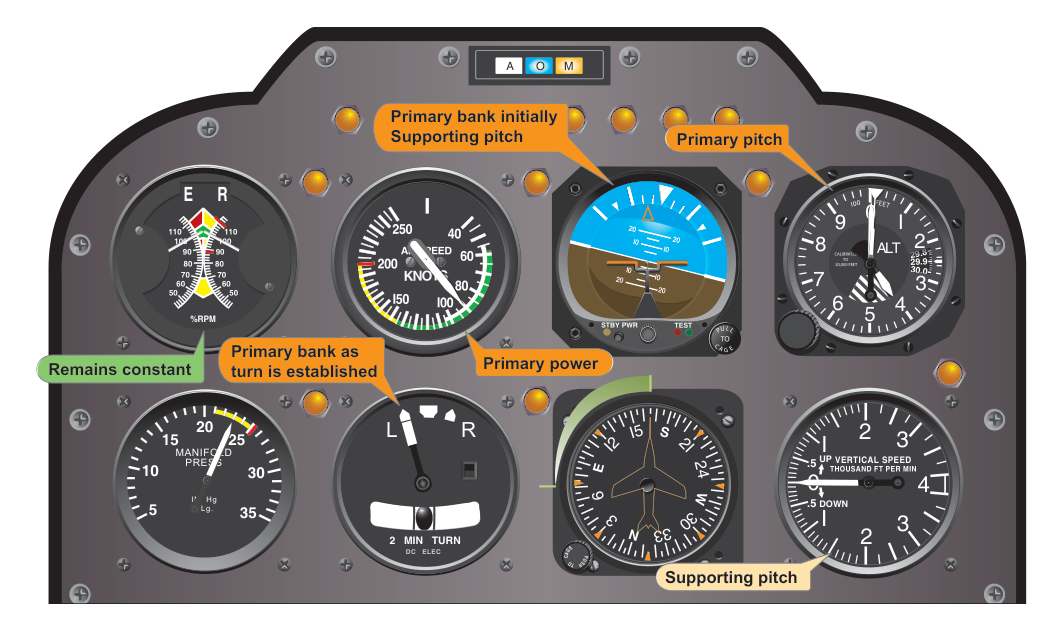
When flying in the clouds, a pilot cannot rely on outside visual references to judge whether the aircraft is turning, how fast it is turning, or when to stop. Instead, every maneuver must be flown by reference to the cockpit instruments alone. One of the most fundamental building blocks of attitude instrument flying is the standard-rate turn — a disciplined, precisely controlled turn that rotates the aircraft at exactly 3 degrees per second. At that rate, a complete 360-degree turn takes exactly two minutes, which makes timed turns a reliable navigation tool and gives ATC a predictable model of your maneuvering.
Mastering standard-rate turns means understanding the relationship between airspeed and bank angle, interpreting multiple cockpit instruments simultaneously, and coordinating the controls smoothly enough that altitude and airspeed stay pinned while you rotate to a new heading. This article breaks down the mechanics, the instrument interpretation, the key numbers, and the exam traps you will almost certainly encounter.
What Is a Standard-Rate Turn?
A standard-rate turn (also called a Rate 1 turn) is defined as a turn at 3°/second. Completing 360° at that rate takes exactly 120 seconds — two minutes. This rate was established because it is achievable and maintainable in typical instrument conditions without excessive bank angles, and it gives consistent, predictable performance that ATC uses when issuing instructions such as "turn left heading 270."
A related term sometimes encountered is a half-standard-rate turn (Rate ½), which is 1.5°/second, used at higher airspeeds. FAA handbook guidance does not define a "Rate 2" turn for general IFR operations — standard-rate (Rate 1) and half-standard-rate are the terms used in practice. In general IFR operations, the standard-rate (Rate 1) turn is the default.
How Bank Angle and Airspeed Are Related
The bank angle required to achieve exactly 3°/second is not fixed — it increases as airspeed increases. At a slow airspeed, a shallow bank produces 3°/second. At a higher airspeed, you need more bank to achieve the same turn rate. The widely used approximation is:
Bank angle = (True Airspeed ÷ 10) + 7
For example, at 90 knots TAS: (90 ÷ 10) + 7 = 9 + 7 = 16° of bank. At 120 knots TAS: (120 ÷ 10) + 7 = 12 + 7 = 19° of bank. At 180 knots TAS: (180 ÷ 10) + 7 = 18 + 7 = 25° of bank. These are approximations, but they are accurate enough for practical cockpit use and are the values consistent with FAA handbook guidance.
As a practical ceiling, when the calculated bank angle would exceed 25°, pilots typically limit themselves to 25° of bank anyway, which produces a turn rate somewhat less than standard-rate at very high speeds. This keeps the load factor manageable in instrument conditions.
The Turn Coordinator: Your Primary Indicator
The turn coordinator is the primary instrument for establishing and maintaining a standard-rate turn. It displays a miniature aircraft symbol that banks left or right. When the miniature aircraft's wingtip aligns with the index mark (often labeled "L" or "R" and marked with a line), the aircraft is turning at exactly 3°/second — standard rate. The turn coordinator senses both rate of roll and rate of turn, making it responsive during the entry and steady during the turn.
Do not confuse the turn coordinator with the older turn-and-slip indicator, which displays a needle rather than a miniature aircraft. The needle's deflection to the index marks also indicates standard-rate on that instrument. Both instruments contain a ball (inclinometer) in a curved glass tube filled with liquid. Keeping the ball centered confirms coordinated flight — that rudder pressure is correctly balanced with aileron input.
Supporting Instruments During the Turn
The turn coordinator tells you rate, but you must cross-check several other instruments to maintain altitude and airspeed through the turn:
- Attitude indicator (AI): Shows bank angle and pitch attitude. Use it to confirm the approximate bank angle calculated from your TAS formula, and to maintain a level pitch attitude. The AI is gyroscopically driven and gives an instantaneous, reliable picture of aircraft orientation.
- Altimeter: The primary instrument for altitude. In a standard-rate turn, slight back-pressure is needed to compensate for the reduction in vertical lift component caused by banking. If altitude creeps up or down, adjust pitch on the AI.
- Vertical speed indicator (VSI): A trend instrument that confirms whether altitude is being maintained. Use it as a supporting reference, not as a primary control instrument, because it lags slightly.
- Airspeed indicator (ASI): Confirm airspeed is stable. Back-pressure in a bank can inadvertently slow the aircraft if over-applied.
- Heading indicator (HI): Used to roll out at the desired heading. A standard scan includes noting the heading during rollout to anticipate reaching the target.
Entering, Maintaining, and Rolling Out
Entry: Apply coordinated aileron and rudder to roll to the calculated bank angle. Reference the turn coordinator to verify you have reached standard rate. Add slight back-pressure to hold altitude as bank increases. Trim if the turn will be sustained.
Maintaining the turn: Keep a disciplined, systematic instrument scan. The turn coordinator confirms rate; the AI confirms bank angle and pitch; the altimeter confirms altitude. Avoid fixating on any one instrument. The classic instrument scan — either the selective radial scan or the hub-and-spoke pattern centered on the AI — keeps all parameters in view. Small corrections should be smooth and deliberate, not abrupt.
Rollout: The standard technique is to begin the rollout one-half the bank angle before reaching the target heading. For example, if you are in a 18° bank standard-rate turn, begin rolling out 9° before the desired heading. At exactly 3°/second, you will complete the rollout precisely on heading. Apply coordinated rudder and aileron to roll wings level, relax back-pressure as bank decreases, and confirm on the heading indicator.
Timed Turns
Because standard-rate gives a consistent 3°/second, you can calculate turn time precisely. To turn 90°, you need 30 seconds. To turn 180°, you need 60 seconds. To turn 360°, you need 120 seconds. If the heading indicator fails or is unavailable, timed turns using a clock or timer become the primary tool for navigating to a specific heading. Many instrument procedures and holding entries rely on this math. Simply start the timer when you begin the turn, hold standard-rate on the turn coordinator, and roll out when the correct number of seconds has elapsed.
Why This Matters in Real IFR Flying
ATC expects instrument-rated pilots to execute standard-rate turns by default. When a controller says "fly heading 180," the assumption is that you will get there efficiently and predictably. In IMC, flying non-standard bank angles without calculating the corresponding turn rate leads to overshooting or undershooting headings, which compounds workload at exactly the moment you can least afford it.
Additionally, holding patterns, procedure turns, and many instrument approach segments are designed around standard-rate turn timing. A pilot who cannot consistently nail a standard-rate turn will find their holding entries sloppy and their approach paths unstable. Proficiency in this one skill underpins nearly every precision task in the IFR environment.
Key Numbers and Rules
- Standard-rate = 3°/second = 360° in 2 minutes
- Bank angle approximation: (TAS ÷ 10) + 7 = degrees of bank
- Maximum practical bank in IMC: 25° (beyond this, limit bank regardless of calculated value)
- Rollout lead: ½ bank angle before desired heading
- Timed turn math: 90° = 30 sec, 180° = 60 sec, 270° = 90 sec, 360° = 120 sec
- The ball in the inclinometer must remain centered for coordinated flight throughout the turn
- The turn coordinator (or turn-and-slip needle) is the primary instrument for rate; the attitude indicator is primary for bank angle and pitch control
Common Test Traps
- Confusing the turn coordinator with the attitude indicator: The turn coordinator does not show actual bank angle — it shows rate. You cannot read exact degrees of bank from it. Use the AI for bank angle.
- Forgetting that bank angle changes with airspeed: Many students memorize "standard-rate = 15° of bank" without understanding that 15° only applies near certain airspeeds. At 120 knots you need closer to 19°; at 90 knots closer to 16°.
- Applying the rollout lead incorrectly: Students sometimes roll out when the heading indicator reaches the target, rather than leading by half the bank angle. This causes consistent overshooting of desired headings.
- Ignoring back-pressure in turns: A banked aircraft has less vertical lift component. Failing to add back-pressure in a sustained turn causes altitude loss — a classic IMC mistake that can be dangerous near terrain or on an approach.
- Misreading timed turn math: Test questions often give an unusual heading change (e.g., turn 135°) and ask how long to hold the turn. Divide degrees by 3 to get seconds: 135 ÷ 3 = 45 seconds. Do not confuse seconds with minutes or skip the division.